The term “rabbit hole” is taken from Lewis Caroll’s Alice’s Adventures in Wonderland. where Alice chases the White Rabbit into a strange world. “Rabbit hole” is often used on the internet as a link that leads to somewhere off the main-grid and on the dark web that is often unsettling and reality-bending. It has been used in films like The Matrix and The Game starring Michael Douglas. Rabbit holes are often posed as easter eggs embedded in the more mainstream (or at least not so hyper niche) media. They are hidden and cryptic puzzles that point to some Alternative Reality Game, enticing the finder to go ever deeper down the rabbit hole into some epistemologically challenging experience. An example is that of the Nine Inch Nails album Year Zero (this sentence is a rabbit hole incidentally).
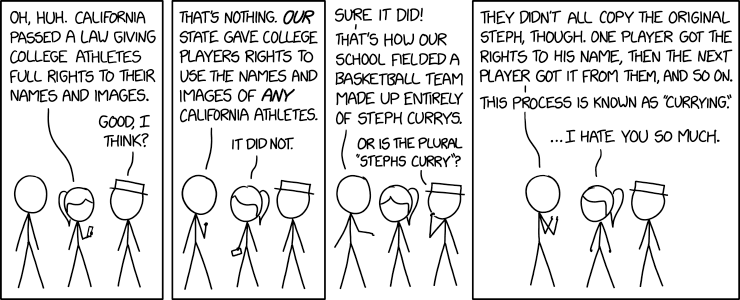
In a more general sense, a rabbit hole is a reference that leads the inquisitive mind to some new field of knowledge that they would have otherwise never even been aware of. They can be sneaked, as easter eggs, into the more popular media, thereby allowing a large candidate audience to find them, even if few ever do. They can also be tagged into memes such that the reference piggybacks on the popularity and spread of the meme. The XKCD site often contains references to obscure pieces of physics and maths that need to be understood before getting the joke. There is an explanation site, but that feels like a bit of a spoiler and a cheat and is kind of a last resort. The following, for example, requires an understanding of lambda calculus, a mathematical topic mysterious even to many computer scientists; part of the fun is working out the puzzle. Curiosity to the reference leads one further down the rabbit hole, and it gets curiouser and curiouser.
There are potential applications for memetics and cliology here. Some memes are light enough to walk with their own legs, others require a propagating index that points to the more bulky and static ideas. This more complex information cannot propagate on its own and so generally needs its audience to know where it resides and to actively access it. One of the challenges for cliology (and other fields such as advertising) is to get people to act on the more complex information in an arena where attention spans are alarmingly short. The last point of the AIDA model of marketing, “Action”, where simple enough to fit in with the advert, can be a direct enticement, but more often than not the action called for is more complex than the advert will carry. The advert then prescribes the action of pursuing a reference along with sufficient incentive to do so: “to find out more visit our site http://cliology.comnow!”
Adverts are fully expected to be overt in their intentions. Any meme that has even the faintest whiff of being an advert tends to come over as forced: forcedness is the Dettol of memes. How then might a simple self-propagating meme induce more complex behavioural responses? Lets ask the Easter Bunny. The principle is similar to that of the AIDA case, but for memes: a simple self-propagating meme with an embedded index behaivour pointing to a repository of more complex memes. To avoid seeming forced, the indexing mechanism would be a recombination of the carrier and an easter egg. There is some trade off that while an unforced meme may reach a greater audience, the hidden easter egg will go unnoticed by many – its a numbers game and a matter of careful perceptual targeting. The viral analogue though is that the meme is contagious during incubation before the symptoms appear, and many carriers are likely to remain asymptomatic. Social media users would share quickly, then possibly respond to the call to action at some later time.
However, were the meme to go pandamic, then there would be enough of those who do spot the easter eggs to disappear down the rabbit hole.
An earworm does not have to be deep and meaningful; the best are utter nonsense. All an earworm has to do is clog up the eardrums. I do, however, like to explore my mind and my emotions as I find this to be cathartic among other things. In the process of writing some of my tunes a lot of background is brought in and this is an observation on the process, I seem to use. Sometimes they transcend into pure pulp, but other times they just linger around at the level of moody introspective self-indulgence.
Its become something of a bank holiday tradition with me, and yesterday was late summer bank holiday; the last one of the year. I like to drive to exotic places like Skegness while listening to my own awesome work and thinking up new songs. I’ve noted this pattern before. Carpe Diem grew out an August bank holiday trip to Mablethorpe a number of years ago. As did More Euphoria which was the result of a May bank holiday road trip.
Such a road trip is a form of soul searching. Hurtling around country lanes at the national speed limit and narrowly avoiding oncoming farm traffic ensures that I have to stay alert, and this uptime alertness allows my unconscious mind to mumble around the issues in my life. I am aiming to get a solid hook-line out of it all but more importantly, I am collecting and collating experiences. I’m trying to work out what I want to convey, not necessarily in rhyme at this juncture, or even in words, but just gathering a clutch of themes that will later precipitate into song. This can be something of a lengthy process and I don’t really know the direction it is going in (much like the road trip itself!). Some of the themes may be lost, or merge with other themes years on. Some might present themselves as lyrics there and then. The important thing to me about all this is that when the themes do cluster together, I have a sense of what the song is about and this gives me scope for more structured approaches to formulating a production.
Having made explicit my thoughts around the onion rings of “Edisoning” earworms, this puts my present experiments and experience into perspective. I came away from my drive, a couple of weeks ago, with So Serendipity – a few lyrical lines that lasted through my drive home and have been bubbling around my mind since. This has made it to a rough sketch of a chorus in Cubase: basic drumbeat, piano melody, some baseline, and words recorded on a cheap mic. It is about sixteen bars looped a few times so that I can play it on my phone and review it while I’m out and about.
Having the potential to be an earworm proper is what allowed the song idea to get as far as a recorded sketch. The instrumental accompaniment has added to the earwormyness and numerous listenings, through mere exposure, had driven it into my mind. Bits of it keep looping in my head whenever I’m doing something that requires little thought: making coffee, going to the loo, writing complexed computer code, blogging. Mixed blessings, but this tonal Tetris effect indicates to me that the song is jumping through a major hoop in its career as an earworm.
The other point goes back to the onion ring theory of assembling memes. The recorded sketch was simply what was going through my head and had the inclination to do at the time – a few bars to think about and develop upon. On replaying it I can decern the bits that give rise to smug self-satisfaction from those that make me cringe. In other words, I am bashing the song against my internal model of selection pressure derived from what I have learned how music “should” be. Now that it is becoming an earworm proper, one that I have enslaved myself with, I find myself mentally hearing the bits that work well, but these lead on, sequentially, to bits that don’t. Consequently, as I’m clicking on an email, or opening a can of beans, I’m casually making variations to the ill-fitting chunks; more out of compulsion than deliberation. These mental variations are going through that good ol’ evolutionary loop, some of them making it to the next round of the onion ring thereby leading up to the next sketch recording session.
There is a method lurking in all this. That method is: to make a recorded sketch, drum it in through constant replaying, then step away from any musical equipment, letting the mind chew on whatever needs ironing out or needs keeping.
In a previous post I came up with the idea of “Edisoning” a hook line: sucessfully finding a thousand hook-lines that do not work!
This relates to a deeper theory I have on creativity and meme assembly which is steeped in epistemology. Epistemology is the philosophical branc1200 × 1076h that consideres how we know what we know – subject that is a bit self-reflexive and invariably gets mind boggling. Most influential to my theory are the likes of Popper, Campbell, and Dennett, as they proposed thoughts around evolutionary epistemology.
To quote Popper: ideas die in our stead
In other words, if we think up an idea and realise its pretty stupid before actually trying it out, then we can dismiss the idea before we do ourselfs a mischeif. We have an internal model of the world against which we can test out, through mental simulation, the costs and benefits of an idea. The idea is subject to a kind of Darwinian evolution where we iterativly submit an idea to selection pressure and make variations on the most promising – in this way we try to envisage the most fitting course of action to take. The selection pressure is applied to an idea according to our mental models of how the world works, which in turn is derived from our learnings and experiences, the pleasure and pain feedback of our actions according to the selection pressures of the physical and social world. The selection pressures in our mental simulations are related to those of the world around us, although their validity is another issue. A thought that gets Darwinised, is one that, when pitched against what we have leared from the selection pressures of the real world, is likely to give rise to some kind of displeasure. So, we kill the idea before it kills us.
There seems to be a form of hierarchy to all this which I view as an onion ring series of layers, each one plying and simulating selection. Where an idea passes elimination at one layer then it moves out to the simulations of another layer, and so on until it encouteres the real world: it goes on to the next round of enducrance.
This can be seen in cultural creativity, music and finding that killer hook. An idea pops into your head and it is most likely to be banished there and then. However, if it does have some merit, then it is worth a bit of time thinking about. If it survives that then it might lead to a test track or demo. If that demo sounds good then you might play it to some friends and get feedback. If they are supportative, then it might be considered as a proper demo and so on and so forth until it reaches an industry professional. If it makes it through all that and is released then it is subject to the whims of a commercial audience.
In each of these stages, people have some idea of what is likely to be popular and this is what constitues the layers of selection pressure. This knowledge comes from exposure to contemporary culture. Hence, knowing the current tropes of popular music helps me to protect my friends, and the wider world from my more experimental avant guarde noises.
Here is a crazed thought at this time of night after a few beers.
I’ve spent some time, some months that is, pulling all my books off the bookshelves, attempting to catalogue them, then putting them back up in a more “sensible” order – I can nearly see my floor again.
Having done so, and looking at the bookshelves now, it seems that the order that I have put them in is affecting the organisation of my thinking. I have no idea what that is about right now, nor what it means.
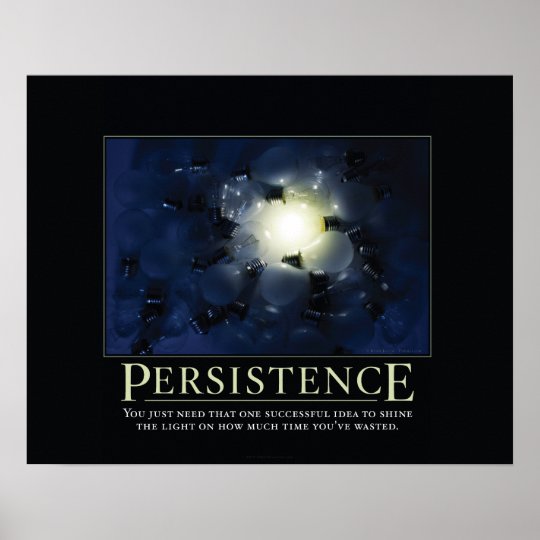
Inspirational posters are a normie meme that gets sickening very fast, hence the rise of the demotivational poster – they take the piss out of the empty hackneyed cliches.
This post isn’t about putting a positive spin on some Sisyphean chore when it would be better to pack it in and go do something more useful and fun. Rather, it is about a meme generation algorithm and a twist on reframing failure into feedback. Ok, a quote:
“I have not failed. I’ve just found 10,000 ways that won’t work.”
― Thomas A. Edison
Think of it this way: the memetic matrix has you and it is hellbent on replicating its warez. Edison’s words are about variation, selection and reproduction and apply both to the biota and ideas. Biological and cultural evolution are great at finding schemata that do not work; these variations just get Darwinised.
In my quest for the earworm, I drive around a lot, gathering inspiration and conjuring up new potential hook lines for songs. Most of them, unsurprisingly, are just shit and are culled by more memorable variants. Those lines themselves might be epic fails, but the process of generating and rejecting them is not. This is a case of sieving through lyrical phase space and recognising the viable from the non-viable.
This process, I suppose, could well be called Edisoning – a memetic algorithm for technological, cultural, and in my case, musical innovation.
In doing somethign we need to know what to do and how to do that thing. There is a relationship between them that seems to go unwritten, but will be explored here.
What and how are two aspects of the noam framework: the “3MVW3” as I have called it where the 3Ms are Mission, Method and Materiel; V is the values; the 3W are Where, When and with Whom. What and how map to mission and method respectivly and are two of the three elements (along with materiel) that comprise the kappa point (top-left) on the noam diagram. Mission corresponds to what; method corresponds to how while materiel is about resources and tooling. Together the 3Ms are what allow us to do things, while the V is the reasons for doing so, and the 3Ws are the context.
In common interpretation, “what” is an objective, the thing we want to achieve; wheras a “how” referrs to the processed by which we go about achieving that given objective. However, a deeper understanding is required. The relationship between what and how is not one of type, but rather one of level. A “how” is a more specific kind of “what”, so that which determines a “what” or a “how” can only be seen relative to other “what” or “hows”. It is possible to state an objective and break it down into the processes involved. When we do so, however, those processes themselves become objectives, sub-objectives of the original statement of intent: we might think of “hows” as being “sub-whats”. By this definition, we can consider that the sub-whats themseves break down further, and so on; we can also consider that the original “what” as being some kind of “super-how” as a component process for some more elaborate objective. The structure then forms a hierarchy, or more correctly. a holarchy whereby objectives are processes, and visa versa, but on different levels of appreciation.
Software development employes top-down stepwise refinement in its methodology whereby software modules are decomposed into several sub-modules and so on. We can think of as a module or routine (as a whole) as being what to do, while the sequence of lines of code in it as being how to do that thing, but the lines of code each become a statement of what to do as they refer to sub-routines which are composed of further sequences of lines of code. A routine is then a sequence of sub-routines and so on. In programming, routines, methods, functions and other code blocks are given names which the computer calles in the prescribed sequence. In essence then the name of a routine (considered as a whole) is a reference to a collection of routine names. For coding, this allows us to understand the structure of the application and reuse code we are confident works.
We can think of “what” and “how” in a similar way. The “what” is a label for conceptual whole, while the “how” is a conceptual cluster of labels. The conceputal whole refers to a conceptual cluster, and each individual item in the conceptual cluster is itself, a conceptual whole. This conceptual partitioning may seem somewhat arbitary, but it is a form of chunking whereby a clutch of ideas (and their labels) are agglomorated into a single chunk (and label). It allows for an understanding of how to do things without overloading our communication. If a “how” is understood, then a simple instruction of “what” will suffice, otherwise the “how” will need to be elaborated and refined to the point of understanding. Again, this is top-down stepwise refinement applied to cognition.
In noam terms then, the Mission, or objective, is a larger chunk that referrs to a Method, or process, whereby each method is a sub-objective. The kappa point of capacity, then consists in actuality, of the stucture of top-down stepwise refinement, breaking down to, or building up, ever more detailed chunks. For the cliological framework, this allows for specification and codability of behaviour through instruction.
Nothing kills creativity and inspiration quicker than the fucked up technology we have become accoustomed to using. Just to prove it, I started typing this post and then wordpress just fucked up and lost everything – fortunatly it was only a few words, but it still pisses me off.
But here I’m talking about musical creativity, and yes this is both a rant and a whine.
Being an electronic musician, I am kind of dependent on technology. I use Cubase for the simple reason that I’ve been using it for decades, its what is on my machine, and I just don’t seem to get along with other systems. A note on discloseure: I’m not being paid by Steinberg or Microsoft or any such corporation, so I can slate their products to the extent to which libel laws will allow me.
I’ve had some delays in my production schedule starting since last year when I had a look at proSonus. I didn’t like the software, nor the customer service of the company, so I ridded myself of the package. But it was after that that the trouble started. Everytime I shut cubase down, the drivers for my DAC would corrupt and give me an endless reconnection thump that was only silenced by rebooting several times and messing with the settings.
Needless to say, this monumental inconvenience became an aversion to launching any music package. Launching such a bloated application introduces a frustrating delay anyway, but that has to be accepted. The inability to close it without having to piss around is a total deal breaker. Obviously, I did all the usual of reinstalling drivers, changing cables, clearing out the registry and so on. I even went to the expense of getting a new firewire card, SSD drive, and cooling. Eventually, I took the nuclear option and made a fresh install of windows on the new drive – with all the farting about that entails.
All in all, this culminated in about seven months of irritation and lost productivity where I only have the demo of one song done. I started a new tune today, and guess what – cubase crashed and lost it all for me.
The moral of this story? I don’t think there is any valid learning point except to fuck it all off and bugger off to the pub (now they are back open).
The cliological frameworks are essentially systems models; the noam framework inherits the properties provided by general systems theory. An individual, organism, organisation, or machine, is within an environment and interacts with its environment across a permeable systems boundary. There is an outside world consisting of other systems which could be living, social, or otherly. The noam itself pertains to the inside world of the considered system. A noam is a viewpoint of a class of idea, and is intended to highlight control and decision mechanisms: it is a cybernetic model. It could be in the mind of an individual, the policies and procedures of an organisation, or in the software running a machine. The noam model abstracts away from the actual form of the system (eg a person) to focus on how interactive behaviours are arrived at. While a noam can be thought of as a specific form of idea (much like a meme is a specific form of idea), a noam encompasses sensation, values, beliefs, capabilities, decisions, actions and learning. It provides a way of looking at cyclic processes.
The symbolism herein for the noam is that of the Phoenician “nun”, or V). The environment is denoted by the Greek “chi”, or χ, which is positioned above the noam symbol, possibly with a dashed line indicating the system’s boundary. In such a depiction, that which is above the dashed line is environmental, while that below is within the system. The interaction between the noam and the environment can be drawn using a pair of arrows showing the input from the environment into the system, and the output, behavioural response of the system to the environment.
[Equivalent FSM/Flowchart/Code] seperate post
Interaction with the noams of others
While the noam model is capable of portraying interactions with a natural environm
ent, it comes into its own when interactions with other noams are considered. These could be other noams within the individual or noams of other people. Organisational interaction is an extension. In such an analysis, we become focussed on the interaction, or communication, between the noams, rather than the actual people. The dynamics are cyclic as each person is a constituent of the environment of the other. The simplest model is that of a dyad, or pair of people interacting – for both persons, the output from one person’s noam is the input to the noam of the other. A typical analysis would focus on one person in the dyad (other analyses are possible). There are various means of depicting this interaction, but a convenient symbolic reduction is to draw the target person’s noam as usual “V)” but place an inverted “ω” over the V shape (aka sad bunny, floptipus symbol)- the result indicates an interpersonal communication between two people, or rather, their noams. This is a special varient of an ineraction with a general environment which may not include the noams of others and would not have the inverted-omega.
perceptual positions
Inverted omega – or sad bunny
Pronouns, such as I, You, They (and their plurals) are indexes to the person, or persons, being referred to. These perceptual positions are often called the first, second, or third person. As perceptual positions are important to the cliological frameworks, then they are elaborated upon. A person’s index to another person can be denoted, as can a long chain of indices. This is done using dot notation: for example, if you were talking about me then that index would be 2.2, whereas if someone else was referring to themselves, then that would be 3.1. Long chains are possible such as 3.2.2.1. Common positions in cliological analysis are 3.1 and 3.2: a target abstract person under analysis, and the person they are interacting with. A noam diagram places the identity of the noam’s operator within the V shape, which could be in dot notation or just some label. The 3.1 and 3.2 types of interaction are common and can be shown simply using the “V)” and inverted “ω” notation without any indexing.
Interaction with the self
The noam has a variety of features, but at its heart is a kind of belief, a belief about an instruction (herin called an instruct) on what to do when presented with a situation. This instruct is formed from values, capability and prior experience. Individuals maintain a vast array of noams and these noams are under constant review. Sometimes, however, a noam may not be able to achieve satisfaction. It is here that other noams that the individual has, come to their assistance. A common situation is being blocked from doing something through lack of an essential resource. Obviously then, the agent would need to acquire that resource first in order to do the thing they originally intended to do. This can become quite a long chain of activities – a “scintillating witches” kind of situation. Were one to solve the problem of having long grass, then a lawnmower must be obtained, which might involve going out and purchasing one, which would require having the funds, which might be obtained through work and so on; or you could just pave it over, which would have a different chain of actions. This form of inter-noamic interaction might be called acquisitional. One noam (termed the front-line noam) calls upon another so as to acquire what it needs to operate; acquisitional noams may further call other acquisitional noams and so on. This would continue in a regress until some acquisitional noam down the chain fulfils its obligation and returns the acquired resources to the caller. That caller can return its results to its caller, and so on back up the chain to the front-line noam and the individual can then do what they set out to do. In practice, the structure of acquisition would be more like a tree: the kind of top-down stepwise refinement used in computer programming. [more detail]
Acquisition often involves tools, or know-how, or knowing what to do; or knowing how to find such out. These are the kappa point on the upper left corner of the noam; from the 3MVW3 memory aid, they are also mark the means by which to do something, that is “mission, method and materiel”. Generally, knowing what to do, how to do it, and have the resources to do so, are necessary to do something; without them, doing that something becomes somewhat frustrated. Hence, to release that frustration and unblock the cloggage, it is usually a case of having to step back and obtain the missing building blocks.
Provision: aquisition from others
Variations on symbolism of aquisition from others
A variation on the acquisitional noam is the provident noam. The provident noam acts in almost the same way, but is done by another person rather than the sample individual – that other person provides some resource that the individual doesn’t have but needs. Commercial activity, the entire global economy, is premised around this. In this modern era of complex manufacturing, almost all acquisition will involve the provision by some other party somewhere along the chain. Provident noams come in two basic flavours: that of push and that of pull. Pull refers to where the agent seeks to acquire some resource from another party. This could be through purchase, barter, imitation, theft and so on. Push, on the other hand, is where that other party is providing the individual with some resource, such as a school providing textbooks or the military issuing weapons. In practice, the push/pull distinction is arbitrary as there will be an element of both depending on what perspective is taken on a transaction – however the dominant intention or most fungible resource in the exchange suggests what view might be taken.
Darwinian bottom line
On the surface (of an interaction) the inputs and outputs are modelled with respect to values. Noams can form a kind of supply chain, whereby the acquisition of resources is done at the surface level through interactions, or transactions, with the environment. However, axiology, the philosophical study of values, which has been backed up by positive psychology, suggests that some values are more foundational and support surface values. In other words, it is not a case of having one layer of values, but, as in the noam model, multiple layers. This reflects the technique of finding core values whereby the question “What is important about that?” is asked repeatedly and recursively. When done, the superficial values are peeled away to reveal the deeper, and usually more motivating values. Money, for many people, is not the value in itself but can be about what it provides, such as security. In other words, noams are driven by a hierarchy of values. Often, in a chain of acquisition, the nomes are driven by the same few core values.
Core values may differ from individual to individual, although overlap is very common. Below the individual core values, at the very foundation, is what might be termed the Darwinian Bottom Line – or the Omega value Ω (a nod to Teilhard de Chardin). Here, the same values of survival and reproduction become common to all lifeforms, and for that matter, replicators. However, the concept of “value” and “purpose” shift away from their superficial meaning, and into more philosophical territory around teleology and dysteleology.
Symbolism
There is a whole symbolic language built around the cliological frameworks which look somewhere between organic chemistry and alchemic glyphs. The semblance is fitting as alchemy, as the forerunner of chemistry, is about structure and transformation. Furthermore, memes are about structure, which has the analogue of the molecular chemistry of DNA. The symbolism does represent a mathematical system. However, it is intended as a kind of shorthand: an engineering schematic for apprehending the substrate of culture. For this reason, the purity of a mathematical system is downplayed in favour of what the picture tells us. A totally coherent system may be possible but is deliberately avoided as it would lead to distracting pedantry rather than teasing out the complexities of the actual phenomenon under scrutiny. Another distinction between the representation of cliological and mathematical ideas is that cliological symbols, for the most part, are functional symbols rather than arbitrary tokens. In other words, the adopted symbol has some inherent resemblance or relationship to the object it depicts. This is why the familiar Latin and Greek alphabets have been supplemented by older writing systems such as Phoenecian: the W) symbol comes from the Phoenician “meem”, which in turn comes from the Ancient Egyptian hieroglyph for water – depicting ripples; this is now our modern letter M. In a sense, the ripples can be seen metaphorically as waves of information that propagate as memes across culture.
a taxonomy of archetypes
While primarliy intended as an engineering schematic, the cliological framworks also provide a symbol set and a grammar by which to model real world cases and manipulate the representation in order to develop hypotheses – to develop novel noams and memes.
The primitive symbols, just as with an alphabet, can be combined and arranged in various ways which have well-formedness, syntax, semantics, and pragmatics. They can be built up into representations that can be seen as the equivalent of words, sentences, paragraphs and so on. A linguistic construction hierarchy is build into the cliological frameworks: toulmin, fabula, noam, meme, cliome. The system can be seen from a structuralist perspective, it provides paradigms for narrative. A retronym for NOAM is Narrative Object Analysis Model; this reflects the idea of Object Orientation (OO) being used in the analysis and design of functional narratives – stories that are essentially instructional.
Common patterns emerge which cover a range of instances; these mostly involve acquisition and interaction. There is a hierachial clustering going on and therefore such patterns can be arranged systematically, according to structure, into a taxonomy: a Linnean approach to cultural information. A set of architypes can be identified and arranged according to some parallel with biological taxonomic ranks. These archetypes are not only useful in positioning a particular noam, meme or cliome case, but moreover, in the development of designer cultural code that is intended for a specific purpose. Marketing, Advertising, Promotion, PR & Sales (MAPPS) provide a clear field for instigating this taxonomy. The most obvious applications for influencing culture are commercial: that of shfiting brand perceptions en mass, thereby retailing more goods. Multi-Level Marketing (MLM) as a method of producing sales through using existing social networks has been [discussed]. There is a diversity of specific compensations plans in and around MLM, but they point to a general pattern which might be considered as both an archetype and a template for constructing new MLM schemes. Other initiatives, such as raising environmental awareness, may be informed by looking at another branch of the taxonomy.
Building on noams: memes
In the cliological frameworks, noams are built from fabula elements, which in turn are built from toulmin elements. Noams go on to build memes, which further go on to build cliomes. This hierachy of construction is covered elsewhere, but it is adding to the noam-meme relationship here. Cliology, in forming a system for influencing culture, is principled on the spread of informtion, and therefore has memes at its heart. Noams are important, but they are considered to be just a building block in the assembly of memes. At the noamic level, the focus in on the individual, or individuals, in an interaction. This is the stuff of conventional communication and psychology studies. To move to the memetic is to shift focus to a populational level. Of course, a population consists of individuals and so noams remain meaningful. However, choosing to address the individual or populational, depends on the scope we are interested in; the interest of cliology is populational. As argued, an engineering perspective of memetics considers a meme to consist of two noams: a payload and a carrier.
The symbol system is extended to accommodate the two noams of a meme: a meme essentially being a replicating noam. It is at this level that the benefit of a Linnean taxonomy of archetypes becomes beneficial for cliology as the archetypes may be deployed as templates for fabricating novel memes for specified intentions.
This standard boolean (2X2) model considers the relationship between the intent to spread some idea and the actual spread of an idea.
Two axes of binary values
Intended spread: {unitended, intended}
Actual spread: {unspread, spread}
Four quadrants
unintended unspread: a simple message
intended unspread: forced meme
unintended spread: accidental meme
intended spread: designer meme
The intended spread scale could be extended (but isn’t done here) to include the intent not to spread, as in secret information. The actual spread of such would be down to something like a leak.
Cliology is concerned with intended and actual spread of designer memes.
 The term “rabbit hole” is taken from Lewis Caroll’s Alice’s Adventures in Wonderland. where Alice chases the White Rabbit into a strange world. “Rabbit hole” is often used on the internet as a link that leads to somewhere off the main-grid and on the dark web that is often unsettling and reality-bending. It has been used in films like The Matrix and The Game starring Michael Douglas. Rabbit holes are often posed as easter eggs embedded in the more mainstream (or at least not so hyper niche) media. They are hidden and cryptic puzzles that point to some Alternative Reality Game, enticing the finder to go ever deeper down the rabbit hole into some epistemologically challenging experience. An example is that of the Nine Inch Nails album Year Zero (this sentence is a rabbit hole incidentally).