What is “realmemetik”
Realmemetik is a made up word for real memes of consequence in the real world, rather than on-line comedy.
Internet meme fads, vs realmemetik
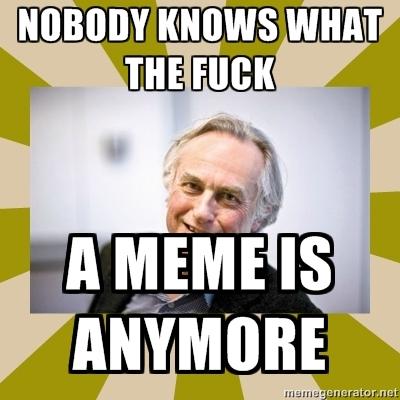
Dawkin’s formulation of a meme as self-replicating evolving information predates the internet by nearly two decades. The web, however, is an environment of pure information flow. It allows the almost instantaneous global sending of information, however valuable, at practically no cost or effort. For this reason, it is the agar of memes. On the internet, the word meme has become synonymous with mildly humourous trivia particularly exemplified by the Lol cat. This has become the popular misunderstanding of the word meme. Memes are of course a wider and older phenomenon, and memetics gives us a handle on cultural evolution. Unfortunately, the reduction of scope of the word meme to viral comedy restricts and trivialises the understanding that can come from memetics. It is therefore necessary to introduce a distinction and reestablish the more general application of the word meme.
To this end, internet memes will refer to those items that are popularly being called “memes”. This allows us to distinguish them from memes that operate in the “real” world outside of cyberspace; those that do have a profound impact on human culture. The word meme itself should be more general and incorporate both real and cyber classes. The treatment of real-world memes might be called “realmemetik”. This is in recombination with realpolitik, of which Wikipedia says:
Realpolitik (from German: real; “realistic”, “practical”, or “actual”; and Politik; “politics”, German pronunciation: [ʁeˈaːlpoliˌtiːk]) is politics or diplomacy based primarily on considerations of given circumstances and factors, rather than explicit ideological notions or moral and ethical premises. In this respect, it shares aspects of its philosophical approach with those of realism and pragmatism. It is often simply referred to as “pragmatism” in politics, e.g. “pursuing pragmatic policies”. The term Realpolitik is sometimes used pejoratively to imply politics that are perceived as coercive, amoral, or Machiavellian.[1]
Realmemetik then is about the practical stuff that manifests and influences our lives, as opposed to the doggerel of the internet. It can arise as maladaptations such as crime, war, poverty and other serious social ills, and for that reason should not be associated with trivia but should be a lever on changing cultural practice. Notwithstanding the gravity of realmemetik, the dynamics of internet memes should not be overlooked. The obvious irrelevance of internet memes serves to highlight how memes in general operate, hence our learnings of the patterns of internet memes can serve to inform us about managing realmemetik.
Vital and killer memes
In genetics, junk DNA is a sequence that does not code for a protein. Perhaps much of the trash culture of the internet could be thought of similarly: the fluff and nonsense of lolcats. However, much of realmemetik does provide for substantial culture: the artefacts and tools, our languages, our social protocols, money, organisations, food distribution.
These are not empty replicators, they are carriers of a payload, they have efficacy, and they are functional. In other words, they are memes that are expressed though something that effects the hosts, either beneficially or otherwise. That they are beneficial to some people (or allie with their existing memes in mind) may partially account for their sticky, spreadable, and likeable properties, but the key takeaway of memetics is that successful replicators are gagued only by their ability to replicate. Benefit (and Dennett asks cui bono?) is one, but not the only, selection pressure operating.
Where there is a successful meme that is effecting something that might be considered counter-beneficial, then the “virus of the mind” metaphor comes into full force. Outbreaks of contagious pathogens give rise to fatal epidemics; they spread but they are not good for their victims. The same goes for some species of meme.
So, we have vital memes such as the highway code and hygiene, and we have killers such as extremism, terrorism, cults. There are memes everywhere in between. The probiotic memes are cultural adaptations, the dysbiotic memes are cultural maladaptations.
Importance of realmemetik
The key distinction between internet memes and realmemetik is that memes expressed in the real world are not just trending nor click-bait humour; they can make or break, success or failure, or even life or death. The cliome/clion distinction, that between the underlying replicating memetic code and the expressed effect become apparent, although the impact of the expression of realmemetik overshadows the code.
We can see realmemetik in the artefacts around us, our tools and technologies, our organisations, policies, laws, routines, in marketing: everywhere where information is influencing what we do, think, say, make or buy.
Many of these are beneficially probiotic and avoid chaos. For example, laws that say what side of the road we should drive on. However, there are many examples of dysbiotic maladaptation in realmemetik: war, inequality, crime, violence, waves of drug abuse, poverty and most social ills.
The virus of the mind metaphor becomes not only apt but useful here. Were we to see cultural maladaptations, not just for their effect, but as the symptoms of a selfish replicating pathogen, then that might give us some insight on how to combat the problems.
Consider the outbreak of a biological disease caused by a virus; this is the subject of epidemiology. Measures are taken to track its spread in an attempt to curb it and save lives. The culling of livestock, or clinical isolation of victims may be called for in an emergency. Preventative measures, such as vaccination and education may seek the immunise a susceptible population in advance.
Epidemiological analysis and intervention may also be applicable to cultural maladaptations that are spread via thought contagion. Psychological pathogens are seen as a communicable disease as they spread through communication of information. That is, dysbiotic ideas can proliferate among a population and be expressed in a way that is detrimental to their hosts. Drug abusers usually become such through exposure to existing drug users and adopting their habits.
In the case of cultural epidemics, it is possible to track the spread of the ideological pathogen. Furthermore, it is possible to “immunise” against infection by providing the memetic equivalent of a vaccine: education, scepticism, alternative behaviours, and so on. Hence, realmemetik has practical implications for public health issues requiring changes in cultural practice and prosocial intervention.

Overlap between realmemetik, internet memes and biological viruses
The digital, the cultural, and the organic are three examples of where information replicators exist. The term “virus” (outside viral marketing) has negative connotations in that it is usually dysbiotic, invasive, and communicable and causes widespread distress. Computer viruses, such as “Trojans” are well known digital manifestations that often result in disruption of business operations. They spread through infected media or web transmission, and while they are common memes on the internet, are not generally thought of as internet memes. Mind viruses are those which infest the human mind, they are the dangerous ideas that individuals adopt through exposure to the ideas of others. Again, the internet may be a medium of transmission but their effect is that of a realmemetik sense, using human brains as their mode of ideological replication. Biological viruses are rogue information replicators that are encoded in molecular form using cellular replication machinery, human or otherwise, for their continuation.
There would appear to be three distinct forms here, but there is overlap between them.

Some real-world memes might be reckless for the individual but have little spread because more sensible people recognise the inherent dangers. Apart from the sensational and the outrageous extremes (ie suicide terrorism), which have limited appeal, there are also real-memes that pose threats to a wider susceptible audience and really should be considered as being a public health concern. Vaccine hesitancy, FGM, the Silicone valley raw-water trend are dysbiotic cultural practices and are predicated on false or conflicting information, sometimes involving conspiracy theories around vested interests.
On the flip side of this, counter memes can be probiotic. Those that do inform and promote hygiene include the 1980s public information announcements like “AIDS, don’t die of ignorance”, or simply the notice in the washroom serving as a nudge “now wash your hands”. In these cases, a probiotic meme is capable of spreading faster through social vectors than the biological contamination, and acting as a kind of immunisation by “heading it off at the pass”.
Internet memes may actually have import; their effects can spill out into the real world and we should not simply dismiss them all just being frivolous nuggets of comedy. Some political and marketing campaigns have piggybacked on internet memes, but there are those dangerous fads which have produced injuries and fatalities from pranks and challenges such as Roofing. The emulation of such acts is where internet memes become killer memes, dysbiotic maladaptations in social behaviour.

While risk-taking behaviour in pursuit of web notoriety and likes may provide an individual with a posthumous Darwin Award, there are other internet memes spill over into realmemetik are threats of epidemic proportions. Anti-vax meme flourishes and where they do translate into vaccine hesitancy, then there is the real threat of immunity deficiency and outbreak of disease. On the other side, the internet is also a vector of health advice, reinforcing lifestyle changes, pub-med, Web-MD. Both probiotic and antibiotic memes are in a propaganda war on the battlefield of social media. As the strapline to the film Contagion put it ‘nothing spreads like fear’ and sensationalism of a health scare, combined with conspiracy theory, is a driver for hoaxes.
An exapmple of fear overtaking fact is the “Momo challenge” which was propagated on the scare that trend weas inciting children to commit suicide. In reality, Momo, a creepy Japanese sculpture, had caused a little girl to cry, but the story, through the chain of re-telling, had become exagerated into tales of a playground suicide craze Snopes. Warnings had even been issued to headteachers. Urgency over raising the alarm, and the ease of doing so over the web rather than the effort of fact checking, had transformed an innocent, if ugly, work of art into an alarmist deamon more dangerous than the reality of the thing. Partly, the hoax was down to the level of digital literacy and concern of the parents. It became meta-hype around a threat that did not exist, and a case of a hyper-real self-fulfilling prophesy. Fortunatly, the hoax was debunked and the meta-hype shifted to revewaling the risk of thinking the Momo challenge was real.
A solution lies on the level of epistememes – about providing a healthy scepticism and to check the sources of information, as exemplified by Snopes in the effort to help audiences spot fake news through fact checking. Epistemology is concerned with how we know what we know. Epistememes (or epistemological level memes), are memes that posited at a higher philosophical level than opinion or “fact”; they weigh up socially spread information for validity. However, epistememes themselves, are spread, like the idea that the media is biased captured in the maxim ‘don’t believe everything you hear and only half that you see’ , or as Public Enermy paraphrase of Poe puts it ‘Dont Believe the Hype’. Epistememes then provide a way of spreading ideological immunity which may improve the hygiene of cultural practice and stem the outbreak of real epidemics. Devising epistememes would be an application of memetic engineering to realmemetik, having a prosocial influence to peoples lives.
Practical realmemetik
It is not within the jurisdiction of cliology to proscribe action, what ever the level of maladaptation, as cliology is intended to be an ethically neutral tool whether used as a sword or a ploughshare. Cliology is, however, intended to equip practitioners with tools of prosociality.

Given what we know about internet memes, about their properties, and their ability to spill-over into real-world, both as dysbiotic problems, and probiotic solutions, then manipulating both internet memes and real memes for the prosocial benefit of changing cultural practice becomes a possibility. The meme as virus metaphor, or gene-like replicating ideas, alludes to an analogue of genetic engineering and vectorology, which have been applied to medical benefit. The memetic counterpart would involve techniques for cutting and splicing component fragments of cultural ideas, akin to sequences of DNA, and be targeted at cultural health.
Much can be translated from virology and epidemiology in the quest to combat cultural maladaptations. In the examples above, a version of the memetic, or ideological vaccine, has been considered, and epistemological education in criticism, in questioning, in scepticism, in reasoning, in not just accepting and reacting to outrage or fads, is a prime candidate for ideological immunity to pathogenic memes. However, cliology, via memetics, goes further than just education; it aspires to systematically design memetic antidotes to cultural pathogens. By adopting a practical engineering outlook, highly targeted probiotic strains, ones which rapidly spread through the human social sphere, can be assembled. Prosocial cultural practitioners can intentionally apply the principle of realmemetik in their effort to combat business, public health and social problems in the real world.