Cliology

Blog

  • A good singalong

    The subject of earworms is interesting. For a writer of popular music, knowing how to churn them out would be that magic formula.

    I believe though that they are some product of cultural evolutionary psychology – that they are some cognitive gadget that employs some structure of the brain and is somehow implicated in the learning of language.

    I’m now beginning to think that they may also have some social function – that of creating social bonds.

    As a member of a barber’s shop chorus, I am meant to learn songs in the repertoire and at least do some preparation for the training and rehearsal sessions – which are being done weekly on-line owing to the CoVID-19 lockdown. This week, I’ve been a bit lax and have only heard the teach-track for new song a few times. There is a strong sense of comradery in barber’s shop, and my lack of effort made me feel as though I was letting the team down to some extent – I know this isn’t really true, but its how my brain ruminates in an attempt to motivate. The issue here though is that there is a value that underpins my learning and I found that I was going over sections in my mind, earworm like, but without the irritation.

    I got to thinking, are earworms implicated in singalongs? The evolutionary psychology of karaoke might seem a little far fetched, but perhaps a regression to the social function of singing along (or other cultural rites) might be more promising. Being part of a tribe, as opposed to being some outsider, has and remains of primitive survival benefit for humans. Knowing the words, the moves, the shibboleths of the tribe, unites the individuals, giving a sense of belonging. Hence it is of social value to learn such in order to be able to join in and be a part of what is happening. Singing in chorus is a powerful way of uniting groups, providing group identity and the strength in numbers that emerge: football chants, national anthems and so on. It follows then that there is motivation to learn the songs, possibly having a deep biological stem as a cognitive instinct. If this is so, then mere exposure to song would activate and reinforce the anatomy and mechanisms that confer the learning of that song – an earworm! It could well be then that the earworm phenomena is related to the Dunbar number and evolved among early hominids so as to form tribes.

    Consequently, as a process that has been maintained in modern humans, this survival instinct has given rise the whole popular music industry. So then, could knowing about the social value of singalongs be the key to perfect pop? It is worth experimentation.


  • Got me a boom!

    Got me a boom!

    The path is often long and narrow. On the long march between initial inspiration and polished product, there are numerous waypoints – signs that a song is going in the right direction. I’ve already documented some of the processes.

    I’ve been laying down the conceptual tracks for something that has been building up over a couple of years. This follows my usual workflow of figuring out the melody, basic rhythm and chord structures and I do this for segments such as verses, choruses, pre, and the anthem separately. Usually, I just use piano, a standard kit, maybe strings and other general midi sounds just to get the thing down. When I have these chunks recognisable for what they are, and with some fiddling I put them together in a short sequence without any repetition of sections, and without intros or outros: verse-pre-chorus-anthem.

    This is when I know I’ve got me a boom! Its a significant waypoint and a time of selection pressure. If these core elements work together then I know the song might be going somewhere. Beforehand, they are just isolated blocks, but in sequence, they form a whole from which I can get a picture of how to progress.

    From then there is of course much more fiddling, getting away from the GM sound fonts, and forming the overall structure. I am currently onto those stages and so will document them later.

  • Spreading the elbump

    Spreading the elbump

    Elbump is another word I made up – that does not matter. I’ve been pushing the elbow bump as a “head the pathogen off at the pass” stratagem for CoVID-19 – people seem to get it but as to whether it will spread or be an effective preventative measure will be difficult to gague.

    I’m finding that adorning that memetic behaviour with, rather than what WHO doctors do in the Congo in the face of Ebola, to say that it is what scrubbed up surgeons do. A more convivial memeplex maybe.

    I got the idea by watching TV. I can in no way claim credit for this. It is clear that the “elbump” behaviour is amenable to convergent evolution – that is, under similar circumstances, it is likely to emerge from a number of sources.

    A letter to the editor in the Times (2020-02-28) “Tackling Covid-19” suggests convergence – I will cite it verbatim:

    Sir, It may be high time to abandon the handshake as a greeting (letter, Feb 27), but substituting two hands placed together and a graceful bow will be impractical if the left hand is already in use for carrying something, often a bag. In a networking session at a conference in the City last week delegates were using the right elbow, sleeved, to touch that of the other party. It worked well.

    Anthony Rentoul

    Twickenham

    An outbreak of “elbump”? It’s interesting that my ego kicks in screaming “I came up with that!” of course I did not, I just figured it independently.  OK,   I dubbed it the “ elbump” but that’s a bit shit really. The point here is, how to spread this potentially protective measure, irrespective of its origin.

    Anyway, there is no shortage of salutations that can be cribbed, from the Japanese bow to the Roman salute. Indeed, even a handwave or a simple “hello” would do the job. The situation here is that the handshake -grabbing the other’s hand before they stab you – is deeply ingrained in Western culture; it is an automatic gesture, a fixed unit of behavioural patterning. The task is to adjust that pattern in such a way that hand contamination is avoided, but also to make the gesture something that is not too alien, that it can be easily learned and substituted for a more familiar pattern, that can be understood as a handshake, understood for its value as a means of minimising contamination, and is something that is likely to propagate.

  • CoVID-19: indirect worry

    CoVID-19: indirect worry

    An outbreak of a deadly pandemic – that is a source of worry. Pre-apocalyptic panic and the failure of the supply of essential resources – that is a source of worry. The post-apocalyptic social breakdown into a mad-max dystopian survivalist nightmare – that is a source of worry. The gutter press spouting “the end is neigh” – that is also a source of worry.

    But two things do worry me most about all this.  The first is that anyone with a PhD in something virally related is shitting a brick. The second being that too many people I am conversing with are somewhat blase about it all.

    The media are naturally alarmist while the authorities try to pacify the Populus against panic. My big fear is the consensus understanding. CoVID-19 is just a cold; it won’t affect me! OK, the latest is that for many the direct symptoms will be inconvenient at worst, but we are dealing with a little known pathogen here – not the common cold.

    The perceptions seem to be that it is thousands of miles away or that it is restricted to those who do not wash their hands. I might be somewhat paranoid but none of these assurances or cognitive biases hold. Perhaps it is credo consolans, or arrogance, superiority, pride, or simply not knowing the math, but the small world hypothesis, exponential growth and modes of communication suggest that greater caution is needed when thinking about pathogens with elevated R0 and CFR factors.

    No, my actual fear is that this complacency, this blase approach, is the actual threat – again we return to the problem of dying of ignorance. More to the point is that heathy individuals have less to worry about – that is if they are only thinking about themselves. But thinking that they might just be affected by the sniffles for a week or two can be considered as selfish and irresponsible. Mary Mallon, “Typhoid Mary” may have been asymptomatic, but was a carrier of the disease, infecting and causing the deaths of others. The healthy individual can still spread CoVID-19 causing an outbreak cluster and some in this cluster are likely to mortally susceptible.

    To think that CoVID-19 is “just a cold” is to underestimate the wider threat. This perception also downplays the need to take preventative precautions increasing the chances that the individual may contract the virus, but further that they may pass it on. The WHO chose “CoVID-19” so as not to stigmatise anyone. The press, however, has leapt upon the term “superspreader” which socially victimises coronavirus victims further even though it is none of their fault. Perhaps though, in order to head coronavirus off at the pass, those who maintain an attitude that would put others at risk do need verbal inhibiting contingencies. It is the blase attitude (leading to risky behaviour) that needs stigmatising. Shifting that attitude would encourage hygiene and potentially save the lives of the vulnerable. Perhaps denying the dangers saying “it’s just a cold” might be reframed from bravado to a “Typhoid Mary attitude” – you can die of ignorance if you want, but don’t take others with you!

  • Ebola or Elbow

    The first defence against an outbreak of disease, such as the CoVID-19 strain, is to prevent its spread. There are many factors in epidemiology, two of which are the R0: the basic reproduction rate, and the CFR: the case fatality rate. This current CoVID-19 virus is prominent on both axes and therefore presents the threat of a global pandemic that could kill thousands – it is a matter of concern.

    From what we know, CoVID-19 is spread through airborne body fluids, it also is a fomite: it can linger on surfaces such as door handles and on the hands. Hand washing is indicated in an effort to prevent the spread of infection.

    I have considered health advice as being a meme that spreads through a population and has similar dynamics to a biological pathogen. Memes too can be thought of as having R0 and CFR measures. Some strains of thought contagion are indeed maladaptive and fatal – suicide terrorism is an extreme. Most memes are fairly benign, many of which are probiotic. Health advice, in this light, could be seen as a spreading meme, but with a negative case fatality rate against certain causes of illness. This means, in the case of an outbreak, that those “infected” by the meme are likely to take preventative measures against becoming infected by the biological pathogen. Where a beneficial “mind virus” outpaces the pathogen, then there is some degree of prevention, a kind of behavioural inoculation. The pace of information and disinformation, especially in the digital age, means that memes can leave genes panting far behind, as Dawkins put it. Given the risk posed by CoVID-19, then it would be wise to heed and spread, the advice of hand sanitisation.

    Knowledge of sanitisation came to light in the wake of cholera but can knowing about memes and their higher R0 with a negative CFR serve to prevent pandemics. I call this memetic stratagem “heading off at the pass”, that is, the prevention measures get there before the bug does. It is a case of communicating health measures quicker than communicating the disease and this can be done by either public service information broadcasting or by network casting. It is curious that the catch-phrase “coughs and sneezes spread diseases” propagates through the same orifice as influenza.

    Netflix chose a good time to put on ‘Pandemic: How to Prevent an Outbreak’. It is a few years old and concerns Avian Influenza, Ebola, Anti-vaxxers etc., but is prophetic about the emergence of CoVID-19. In one throwaway establishing shot (S1: E4 – 28:30), a couple of WHO doctors, who are tackling ebola in the DRC, meet. It struck me that when they went to shake hands, instead of doing so, they bumped elbows. I imputed the reason for this as being (and I could be wrong) that health professionals in such risky areas had culturally adapted the handshake in such a way that would reduce the chances of spreading the ebola germs from hand-to-hand. A prudent memetic variation. Given that CoVID-19 can be transmitted through the widespread practice of shaking hands, it would seem that appropriating this bumping of elbows meme would offer a vector for heading the pathogen off at the pass.

    The effort then is in introducing and propagating the “elbow bump” as a cultural practice that replaces handshaking; at least until this all blows over. The shift is much the same as sneezing into your elbow instead of your hand. Utilising the cliological frameworks, this development requires conveying the instruct of the substitute behaviour, the value of adopting it, the instruct of how to spread the gesture, and the value of why it should be spread. It also involves targeting “susceptible cascading nodes”, or “sneezers” (as Seth Godin calls them) who are highly connected in social networks: those who meet face-to-face, possibly shake hands, but also carry the gravitas to spread the meme (ie. clinicians are a good target deme). The gesture is simple enough, but the push motility, that which propels the meme, relies on conveying the risk of CoVID-19 through hand-to-hand transmission, and the benefit the “elbow bump” confers. Obviously, this concerns the individuals, but it is also important to relate how getting others to adopt the practice, making it widespread, might reduce the possible global cost to life. This moves onto a second incentive to spread the practice based on gamification – that of seeing how many you can pass this behaviour on to. It goes with the kudos of being an early adopter.

    These are early days in this experiment, but I’m figuring out what the most effective sequences are and how to apply behavioural reinforcement to the pattern.

  • A pathogen by any other name: CoVID-19

    A pathogen by any other name: CoVID-19

    Tedros Adhanom Ghebreyesus, head of the World Health Organization announced on February 11th 2020:

    First of all, we now have a name for the disease:

    COVID-19. I’ll spell it: C-O-V-I-D hyphen one nine – COVID-19.

    Under agreed guidelines between WHO, the World Organisation for Animal Health and the Food and Agriculture Organization of the United Nations, we had to find a name that did not refer to a geographical location, an animal, an individual or group of people, and which is also pronounceable and related to the disease.

    Having a name matters to prevent the use of other names that can be inaccurate or stigmatizing. It also gives us a standard format to use for any future coronavirus outbreaks.

    Catchy, or what? I guess “Kung flu” didn’t meet those criteria. But is CoVID-19 so named for fear of offending the woke? A few triggered rants on the periphery of the internet won’t help matters, but in the face of a pandemic threatening to kill millions, the naming might seem a little trivial. Evidently not so.

    Big pharma spends big money on branding their warez and protecting them against copywrite infringement, and for obvious economic reasons – they deliberate upon an image to increase their market share. A well “branded” virus is hardly meant to spread the bug, quite the opposite, but it does illustrate that communication is not just about biological infection. We are looking at the communication of memes and moreover, the harm reduction considerations of how those memes might be expressed as population-level behaviour. Accurate diagnosis does help with medical intervention and containment, but there are non-biological implications that spin-off from an outbreak and may indeed be more damaging than the pathogen itself. These are the maladaptations that manifest in a cascade of social, cultural, economic and other knock-on problems of dysbiotic memes.

    To give a thought experiment employing deliberately repugnant hyperbole: suppose a virus got called “dirty bat eater virus”, or “Chinese zombie apocalypse virus”, or “civilisation is going to collapse and we’re all going to die virus” – of course, these are way-way over the top. Even reigning it back in a little, it is all too easy to make inferences, and press sensationalism relishes the fear it spreads in the guise of “public interest” – they tarnished one poor victim with the term “super-spreader”. Seemingly small allusions can make us jump to conclusions when in a state of stress and uncertainty. But like a phobia, as an irrational fear, when self-preservation makes system one instinctive thinking kick-in, then reason and perspective fly out of the window. Socially, this can be a self-fulfilling prophesy, and act as a butterfly effect – a nervous twitch can rapidly become a stampede. Watslawick noted this about panic buying during a fuel crisis. If hysteria spread about the possibility of food shortages caused by an outbreak, then the ensuing panic buying would soon empty the shelves even if there was no actual interruption in the supply chain. Among the complexity of interlocking systems, there would be the risk of catastrophy, and this certainly would not help with dealing with a pandemic.

    Calling the current outbreak “Kung-flu” may seem tame compared to the suppositions above, some may consider it offensive and racist, but the real hazard is that the term itself has all the hallmarks of being a highly contagious meme, and one that carries certain intonations that could have maladaptive social expressions. CoVID, on the other hand, doesn’t seem quite as alarming.


  • Clearing out the earwax

    Clearing out the earwax

    I noted that attempting to learn how to sing socially has improved my recall of lyrics. This was unexpected, but welcome result. I’ve had yet another revelation of the side-effects of learning to sing. I’ve inadvertently started to listen closer to the lyrics.

    I was playing Taylor Swift’s “Out of the Woods”, I might have mentioned that Max Martin is a goddam hero of mine. This song was released as a single, but to me, it sounds a lot like album filler with that old Millenium whoop. It isn’t particularly noteworthy and I just let it murmur on in the background when I’m driving. The strange realisation was that I picked up a subtle nuance when I think I might not otherwise have done having not started all this singing shenanigans – it would have washed over me without my ever knowing nor caring.

    It’s that bit which goes “are we in the clear yet, in the clear yet, good” – go listen, I won’t labour the details, but I figure that I’m amazed that I noticed something – actually, I don’t have a word for this kind of experience yet, something like a micro-epiphany or whatever. Needless to say, I’m gobsmacked by how learning one skill permeates into other capabilities without me knowing.


  • Outbreak 2019-nCoV

    The first two cases of the coronavirus were confirmed in the UK today. As a memeticist, I have an interest in the isomorphism between mind and biological viruses and have been following the patterns closely.

    Image result for contagion film

    The actual spread of the outbreak is concerning, but even more so is the handling of information and news. I think I’ve seen just about every pandemic and zombie apocalypse film made; I see these as narrative thought experiments with a ranging from actual insights down to outrageous ketchup-fests.

    Perhaps a simple yet profound point comes across from the strapline for the film Contagion: “Nothing spreads like fear”. This is a reference to mass hysteria in the face of some perceived existential threat to humanity. It would appear to be a deep instinct, possibly akin to the stotting of gazelles, whereby a wave of panic propagates faster than the pathogen. That the social wave moves quickly is evolutionary wise quite prudent, it is an advanced warning call that stems the spread of the contagion. It is also possibly the reason why vampire and zombie narrative resonate so deeply in our collective psyche.

    In the modern hyperconnected world, international transport has increased the capacity for a pathogen to become a global pandemic. Digital communications have, at the same time, enhanced the spread of information, whether fact or fake-news. Fear now spreads as fast as the internet connection speeds. The tabloids, as ever, peddle their spectacular fear-mongering headlines. The authorities, on the flip side, are desperate to quell the mass panic that could easily emerge as the resulting apocalyptic social breakdown would significantly hinder efforts to curb the primary disease. But the “keep calm and carry on” propaganda is cliched cold comfort at best – sanitised newsfeeds attempting to maintain social order, belie the real extent of how much we should be worried, or how terrified those in the know truly are. We have heard the pacifying broadcasts too many times, and fully understand they are primarily intended to impede the inevitable stampede.

    So, we now have two problems – two contagions, one genetic and the other memetic, both of which are highly hazardous. My calling is to see how the genetic contagion might inform the memetic.

    There is an old saying that “birds of a feather flock together”, which is a social metaphor meaning that people with similar characteristics tend to spend time with each other. These could be communities of interest or practice or whatever and can be geographically proximate or, given the internet, disperse; often they are a mixture of both. I have adopted the term “deme” which denotes a sub-population, or sub-cultural, category as determined by the memetic characteristics adherents share in common. A deme then is a tightly linked cluster, possibly a clique, in a social information network. But it is not just a saying, it is based on the fact that our feathered friends agglomerate according to species. This fact became important in containing Highly Pathogenic Avian Influenza, the killer H7N9 bird flu virus in 2016. While thought to spread to humans through intensive poultry farming and movement in China, the risk of international transmission came from wild migratory birds. Understanding the migratory patterns, seasonality, and flyways of potentially contaminated species, gave some insight into that vector from east to west and assisted with the tracking an interruption of the diseases spread.

    image

    The metaphorical meaning stops being idle when we consider that people with similar characteristic often come into the proximity of each other: clubs, churches, workplace. Such gatherings are where people communicate both information and their germs. The internet has meant that many individuals of certain interests may never meet directly, but still, there is a raised probability, given small world theory, that the level of information sharing is proportional to social distance, shared characteristics to the degree of contact, and memetic communication to viral communication. We could consider that “birds of a feather”, memetically might be used as a predictor of epidemics among demes. Indeed Nicholas Christakis has shown that patterns of social networks are a predictor of infection and has given a two-week advanced warning, although he did not employ the viral metaphor inherent in memetics.

    It may be true that nothing spreads like fear, but waiting for mass blind panic to take hold is not an ideal situation. No, it would be better to find more benign indicators that not only predict the spread of disease but also predict the spread of fear – that way intervention and interruption could be attempted. Being of a feather suggest proximity among a deme arising through a common interest: there will be memetic information slushing around that deme. A viral agent infecting that deme would have some dynamics in common with the “mind viruses” such that the memes preempt the patterns of disease spread. Could it be then, that tracking memes would allow forecasting of disease? Perhaps some parallel to of a die or isotopic label might be conceived, whereby we could monitor the information flyways for incoming memes and biological pathogens.

    Foreshadowing memes would enable a state of readiness for making prompt intervention. However, much intervention can be seen in memetic terms and public health messages are sound examples. Basic hygiene awareness, incentives to vaccinate, use of condoms, and so on are kinds of memetic inoculation in advance of diseases – the head the virus off at the pass, as it were. They can be seen not so much as mind “viruses” but rather probiotic contagions carrying a kind of negative Case Fatality Rate.

    The realtime map of 2019-nCoV cases has a few more red dots on it tonight – it looks as if it has a dose of the measles. It is a little late to track the memes as this plague has already hit our shores. The whole thing could go a few ways but whatever happens in the next few weeks we can be sure that strains will continue to mutate, spread and kill.


  • Pre-fetch

    Pre-fetch

    To get my pre-demo songs a bit better, before hiring pros to do a proper demo, I decided to learn how to sing a bit better. I joined a barbershop chorus and I’m learning tons.

    I’ve already noted the possible link between earworms and learning. It interests me strangely how this can manifest, especially with my emerging skills acquisition.

    I put on some tracks the other night that I haven’t played for time. Not an easy track to sing along with, too wordy and fast-paced and I don’t really know the words never having had any compelling reason to do so, but I “sing into the hairbrush” nevertheless. As I say it was some time since I last sung along to that track, but This time i actually found i knew the words better than usual.

    How come? Thats something I would have to NLP out. Hereis my current model so far: i think that singing in chorus demands knowing the song. Peer group pressure installs that value. So, that demands learning how to learn, a meta-cognitive skill – a cognitive gadget. So, learning to sing socially has conferred a cog. I need to confirm this but i gather the new skill is about, rather than just belting it out along to the tune, that I’m thinking a little bit ahead- a beat or two perhaps. My brain is learning how to “pre-fetch” in computing terms. I’m now noting that this seems to be the case in reheasall – im attempting to pre-fetch the words and pitch now, whereas before any training (or any social need of being a member of a chorus) i might not have done.

    This cog makes sense from a formal training angle, although I might not have spotted it if it weren’t for my surprising new superpowers of knowing the words of old songs better now than i did before. This cog seems to have bled over, without my intention, into augmenting previously acquired behaviours outside the specific context of choral singing. I now sem to be prefetching the words and tunes of stuff i learned ages ago where previously i would not.

    Again, just an observation I dont know if it means anything or whether it’s useful.

  • The evolutionary psychology of music

    The evolutionary psychology of music

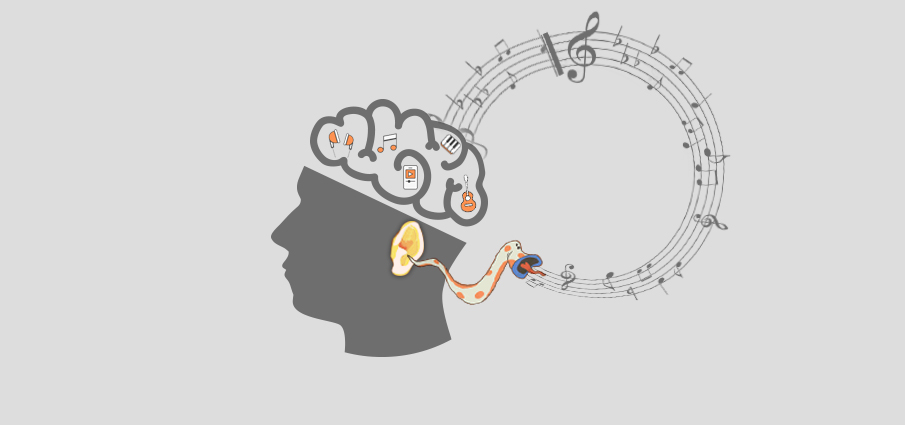
    The earworm idea says that more sticky lyrics are those most likely to linger in the mind. This reflects Cambellian evolutionary epistemology whereby Darwinian forces are acting on the memes in the mind. But music, it would seem, is some kind of cognitive gadget – a deeply ingrained inherited human feature. Cultural Evolutionary Psychology must then ask, what is the survival advantage of being a musical ape? In other words what are earworms “for”?

    One plausible hypothesis is that they are somehow implicated in language learning. This notion isn’t watertight but might have some practical use for making more sticky earworms.

    The learning hypothesis, that music is implicated in pattern recognition and imitation seems to bear out in my attempts to intentionally learn both Japanese and songs for a choir I am a member of. It also seems to fit with the earworms I pick up unintentionally from BBC Radio One which annoy me all day. The phenomenology of this demands attention elsewhere, but for now, I will focus on how a cognitive instinct for auditory pattern acquisition has application in fabricating catchy pop hooks.

    Image result for brain languageLet’s assume that human neuroanatomy has evolved to facilitate language acquisition. Babies imitate language instinctively – it is a part of our genetic “starter kit”. Those bits of the brain are stimulated in learning and using language, and from a contextual behavioural science perspective, that stimulus becomes reinforcing through social feedback such as praise or correction. An audio sequence looping in the mind helps learning; in our mind’s ear, we repeat a word or phase we have picked up until we get it. This mental rehearsal seems to help the new phrase sink in and become easier to recognise and say, which is somehow satisfying. It also makes what we have learned easier to compare against further examples thereby either reinforcing or correcting our learnings. That sense of “getting it” or having “got it” has a pleasurable aspect and presumably is what the mental looping of audio sequences is about.
    This could well be the neurological foundation for earworms. It is unlikely that our ancestors evolved to have irritatinng ditties playing in their heads while, to use a cliched trope, chasing wolly mammoths. Rather, as with the meme as parasite metaphor, earworms are those sequences that hijack our mental musical machinery. Given that composers succumb to, and express the earworms they generate, and that the music industry feeds from them, then there is selection pressure to adapt ever more sticky ones. If this is the case then the composition of a strong hook relies upon those traits that tickle the brain’s receptors.

    Analysing this from a practical direction, we might posit that, as strong earworms must posess reinforcing traits, then we might look to them to figure out what traits we need to make a hit. The distinguishing characteristics of popular music are those that meet a cluster of selection pressures, not only those coming from our received culture, but also of the underlying genetically determined anatomical structures specific to language learning. The traits known for making smash hits could well show us what those neurological tickle-sticks are. My guess is to figure out why they do that, but that is one for later on.