Marketing
Advertising
Promotion
Public Relations
Marketing
Advertising
Promotion
Public Relations
A good old fashioned working class Yorkshire lad goes in our local pub. I’ll call him anti-Paul. Paul isn’t his real name (although he will never read this), but the “anti” comes from him being negative towards just about anything. He is a regular typhoid Mary of that hardcore mindset, stalwart in his own opinions, but cannot see how they are self-limiting. I suppose that is true for most of us to some extent, but this one borderes on characature. He is actually a good guy, but I use the hopefully not too offensive name anti-Paul to innoculate myself from accepting anything he says at face value. He and his ilk (ie my own Dad) might well be considered as an unquaranteened reservoir species of Z memes. I’ve been picking some out.
One of my favorates is that of “useless knowledge”. As I self-identify as an engineer, and judging from some of the wishy-washy studies I have read, I sympathise to some extent. However, in difference to pure research that hasn’t attracted an application yet, I believe, as a Z meme, “useless knowledge” is meant to imply valueless knowledge. Academics and philosophers would provide arguments about the value of such knowledge (which engineers would find largely impractical.) While Paul’s opinions appear to be based on practicality, and I’m sure that is true in his eyes, there is likely to be something going on there, a whole self-sustaining memeplex, which as a Z meme is both limiting and dangerious. Identifying and eliminating maladaptive memes is a practical aspiration incedentally – but I’ll waffle about it here.
Drilldown: //Grand Framework 0.1.0/Cliome/Meme/Noam/Sigma
The processes of direct selling and multi-level marketing are analysed using the cliological frameworks.
Both the set of customers and the set of vendors are demes. A deme is sub-population within a species of adherents in a culture as defined by the cliomes that they adhere to: the adaptive meme complex or memeplex, that they have in their brains (cliomes are built from a framework of communicable noams ie. memes, which are behviour related components). The customer deme are the set of people (or companies) who have the cliome of wanting a solution to their situation, be that some product or service. In framework terms, they are situationally aware of their frontline engagement, but are frustrated by lacking the potential response, and therefore invoke aquisitional engagement. They don’t currently possess the know what, know how, or resources or tools to solve their problem so are in the market for some product or service which can help them. An unkempt lawn can be annoying to a proud gardener; they want to do something about it. The vendor deme are the set of traders (possibly companies) that have a cliome of being able to provide a solution, in the form of products or services, to others who are in some particular type of problematic situation.
The concept of a cliome is almost synonymous with that of a memeplex, a coherent cluster of memes, or placed in framework terms, a cluster of communicable noams (noting that not all noams are necessarlity communicable; those which are become memes). Here then we have interactive engagement between the noams of a customer in one deme, and the noams of the vendor in another. The interacting noam of the customer is aquisitional and in the service of their fronline engagement noam – two essential noams in this situation. To say that a noam is either aquisitional or frontline, is somewhat relative, but aquisitional noams are those that act in the service other noams, whether those other noams are frontline, or further aquisitional noams, or whatever. In the lawnmower example, the frontline noam is concerned with dealing with long grass, the aquisitional noam is concerned with obtainng the tool of a lawnmower that would service the frontline noam of cutting the grass.
An interactive noam could be frontline, or aquisitional, but the key feature is that it interacts with the noams of others. A sales transaction between a customer and a vendor is an interaction between noam in a customer deme and a noam in a vendor deme. The act of buying a new lawnmower is one of aquisition, whcih requires interaction with someone who is selling such a device. Conversly, the act of selling a lawnmower might be termed “provident“, as they are providing something to someone. Again, the terms are reletive. From another perspective, one person is providing money; the other aquiring it for some later frontline purposes, such as buying things that they need. The customer-vendor relationship usually indicates the flow of the fungible resource of money. When examined this way, the frameworks not only show the “value chain”, but also that the chain is really a network topology of a circuit, not dissimilar to an electrical one.
[diagram of interactive noams and value circuit]
So, in this model the customer has an aquisitional noam interacting with the vendor’s provident noam. Actually, these noams are memes, as they are culturally aquired, the individuals involved have learned how to buy and sell. However, to simplify the modellinig, the replicating component (psi) is suppressed and left inferred as it is not essential to the examination of a direct sales case. Looking at the interaction between the direct sales case will inform the MLM case.

Lets think about these in more familiar terms. Someone who is proud of their home sees that their grass is getting long; they are not satisfied with this situation and want to do something about it. It becomes apparent that a lawnmower would be useful, but they don’t have one and so have to do something about that first: go and buy one. That person then pays a visit to the garden centre where they see a range of products, talk to the salesperson about their requirements, listen to recommendations, choose a model, and purchase it. They then go home and cut their lawn, then sit around in their garden.
So, to that person, their underlying value is pride in their home. Their situational awareness is that the grass is long. This situational awareness clashes with their values leading to dissatisfaction and therefore corrective motivation, but this is frustrated through lack of means of currently possessing a lawnmower. This is the frontline noam of the customer. Such frustration leads to the aquisitional noam with an underlying value of having the means for cutting grass. The situational awareness of not having such means (as already given) clashes with the value here, and so indicates corrective motivation. This is not frustrated though as, while they might not presently have a lawnmower, they do have the means to obtain one, and that action is invoked. The aquisitional noam is now satisfied as the value of having the means for cutting grass has been met, and no further corrective aquisitional behaviour is required. Notably, aquisitional behaviour doesn’t affect their pride in their home, and the grass is still growing, so there is still a clash. What it does do is allow the corrective motivation to be channeled into action, the homeowner can now mow their lawn, and when they have done so, they will have short grass. The situational awareness then becomes that of having a neatly mown lawn, which satisfies their values pf having pride in their home – bliss. To summerise, frustration in the frontline noam calls for an aquisitional noam, which can be satisfied in this case. Satiosfation of the aquisitional noam then provides the means to go back and satisfy the frontline noam reacing a state of unistable-equilibrium. These are the two essential noams in a cliome that define a customer deme.
Va^Vf)
An ineraction occurs when two people communicate with each other. When the homeoner walks into the garden centre, a interaction begins. The sales staff will watch them browse around the lawnmowers, looking at prices and specs, and at some point will give signals that they need assistance. They can approach with an “are you being served?” opener and get into a conversation. The values of the vendor, through the sales staff are selling goods, customer service, and utlimatly making a living and a profit. Their situational awareness is the presence of a customer, which presents a prospecive sales opportunity. A quiet day for sales is not so satisfying compared with a good day and the presence of the customer is motivation to use their sales skills. This is the frontline noam of the vendor, and is satisfied when a happy customer leaves the shop with thier new lawnmower.
Vp)
The essential noams in this scenario, and there could be others, then are the customer’s frontline (stimulated by seeing long grass), and their aquisitional (of not having a lawnmower); and the vendors frontline (of spotting a customer). The customer’s aquisitional interacts with the vendor’s frontline.
Vp^ Va^Vf)
This all might seem like labouring the point to shoehorn something obvious into some mathematical system, but of course, this isn’t a guide to selling or buying lawnmowers. Of course, sales people are welcome to find ways of applying it, such as identifying and addressing the clash between a customer’s situation and values; essentially this model is an extension to FAB selling. The point here though is to identify the general pattern of dynamics in the sales transaction and understand the behavioural components of similar scenarios. With a model of the basic direct sales pattern, we can now move on to see how MLM builds upon it by introducing viral components. A more systematic understanding of the viral dynamics could well be used to help sales directors harness the power of referral in human social networks; a move away from “unicorns and rainbows”, and towards a contextual behavioural science of going viral.
[MOVE MOST OF THIS TO FRAMEWORK EXAMPLE
In the frameworks: noams consist of two fabula elements, and fabula elements consist of two toulmin elements; a noam is therefore four Toulmins. The two fablua elements of a noam are represented by the two oblique sides of the inverted triangle (each side is therefore two Toulmins.) The left-side represents motivation or otherwise, while the right-side is about satisfaction or dissatisfaction. Dissatisfaction arises where the situation clashes with values thereby inducing a need, or motivation, do do something about the situation. Consequently, the right-hand side fablua element of the noam (dissatisfaction) drives the left-hand side fablua of the noam (motivation). Let’s disassemble the customer’s left-side of satisfaction or dissatisfaction with a situation, in terms of direct sales, first.
V)
Fabula was inspired by FAB selling and is therefore a useful way of examining direct sales. FAB sellinig referrs to Features, Advantages (or sometimes Attributes), Benefits, and really offers the sales person, who is thinkiing on their feet, a nmumonic for a sales structure. Feature dumping can easily bamboozle a customer. This is where they are told specifications of the product, but the problem is that they might not know what these things mean. The classic example is a tech geek bragging about processor clock speeds to a senior customer who just wants to be in contact with her grand-daughter in Australia. Because of the FAB selling model’s limitations, it has been extended to FABULA which considers both the vendor and the customer, or rather their mindsets, and the bridge between them. The FABULA framework is described in detail, but is summerised here.
A FABULA (or FABVLa, see the page) element is of the logic structure of Toulmin framework arguments – or logical reasoning. One argument links a product’s features (ie specifications) to the advantages that it could confer to someone (the FA argument). A second argument links the values of a particular customer to the things they might like; the kind of property that would satify their values (the VL argument). A third argument is that of bridging wherein the advantages of the product are associated with what the customer likes. So there is a Toulmin framework argument on both the product and customer side, and also one that brings them together (the B argument).
[move some of this?]
Without going into depth about Toulmin arguments here, the essence of their present application (and there are some other aspects relevant to the fuller framework) is that they have a claim, the truth of which is yet to be determined, and a grounds, the truth of which is known, or at least agreed upon. The truth of the claim is based on the grounds, but deducing the claim also calls for a warrant: the warrant is a rule that links the agreed truth of the grounds to the assessment of the claim. They resemble a material implication in logic, however there are some philosophical differences. They are structured
So, back to the product firstly – the FA argument linking the products features to advantages. The specification is essentially uncontestable, they are printed in black and white on the spec sheet, but how these translate into advantages (or attributes) may not be self-evident and therefore need explaining. A warrant might not always be required in practice, or might consist of a chain of arguments, but the structure is:
So given
So, the vendor can explain to the customer what the advantages are. For example, a lawnmower may have a 30 litre grass box, which is larger than most competing models, and so more time mowing and less time emptying.
purely down to the product But this ignores the custoemrs needs. the VL side of the argument linking the customer’s values to what they want, need, or would like. Again, what a customer says they value is gospel as the customer is always right. What they need, or think they need, is a different matter.This is a distinction [covered in a differnt section] between what is deeply important to them, and the method of satifying that underlying value. How the values that the cherishes, can be serviced through aquiring what they need may also require some explaining which also carries the structure of a toulmin argument. Establishing what the customer values and finds important is down to communication with them, which is an art in itself.
So given
So, the vendor, once they values have been elicited then suggesting what may suit them would be of the form, “So if you value that, then you probably would like this”. It could be that the customer is proud of their lovely garden. Then it could be hypothesised ) that they would like to spend more time enjoying the fruits of their work. This can be confirmed quite easily by putting that to them.
So, from the two essentially uncontestable grounds of product features and cutomer values, we can establish the claims of the advantages that the product offers, and what the cusomer is bound to like. The final part is bridging those claims: showing that the product offers what the customer wants and is therefore of benefit to them, the B. If the sales pitch is done with finesse, then the customer is likely to join the dots themselves. This could be put in toulmin form, but for simplicities sake, is just a case of associating the likings of the customer with the products advantages. If these don’t match then a sale is unlikely, for example, if the customer lives at the top of a block of flats, then they are unlikely to appreaciate the merits of a lawnmower, however great they might be.
Put together, this gives us a fablua structure bridging the both grounds of product features and customer values. Moving back up to the noam framework, this gives us the right-oblique side of the inverted triangle: the link between the situational awareness (sigma) and the values (nu) which are evaluated (pi) for satisfaction or dissatisfaction.
/
[noam pi analysis explanation in direct sales]
Someone who is aware that a situaion and their values are in conflict, in these terms, is a potential customer. They may value their home and garden, but they can see the grass is long – this forms a conflict, a sense of dissatisfaction, and therefor the urge to do something about it. The features are long grass, the values are homely pride
A noam is of the structure: V)
Hence a noam, in fabula terms is rendered as two fabula elements:
COBRA analysis
[fabula reduction]]

Part one of this mini-series looked at some of the stages between having creative inspiration and getting something into a Digital Audio Workstation.
So far there is a barebones backing track and a vocal line that is more intended as a guide to the lead melody. This is usually a good point to mixdown and keep listening and listening. The track so far is a draft that mainly gives me an impression of the overall structure. Nothing is set in stone at this point; any aspect of it is subject to revision.
At this stage, I am wanting to develop a good idea of how the verses will progress. Of course, this is genre-dependent. House lyrics tend to be vacuous “Oh, baby baby”, “Yeh! yeh! yeh!” stuff. It is more of a vocal tone over the beat and anything more sophisticated would stretch the genre. Country, on the other hand, tends to epic melancholy tales intended to play on the mind. These are tendencies; not rules.
I tend to find that it does help to have some theme, however simplistic or convoluted. However, country type songs are subject to more selection pressure than are house tracks. House lyrics don’t have to make a lick of sense; country requires a coherent narrative arc. This selection pressure, accommodating for the competing and often conflicting needs, translates into the amount of effort required to make the lyrics meaningful within the genre. Three strong verses and a chorus of a piece portraying a complex story will require much more thinking about, variation and revision, to convey the message while at the same time preserving rhythm, rhyme and all the other good stuff.
The first verse can be a breeze; subsequent ones can be a headache from hell. This is because one of the selection pressures is that each lyrical element of the song must conform to every other across several aspects. The initial effort is so much easier as it has nothing to conform to. But, any additional material has to conform to what is already there, or what is already there must conform to the new stuff. Trying to write in a linear fashion has its appeal, but is thwarted by emerging complexity as a combinatorial explosion of selection pressures raise their ugly heads. Although, when sorted, that is what makes for a strong song.
How can this complexity, this “writer’s block” be circumvented? Well, cybernetics calls it requisite variety, psychotherapy calls it cognitive flexibility, most of us call it creativity. This is the ability to be more flexible than the problem, the ability not to be stuck with a limited set of non-working solutions, but to generate and test new solutions that might work. The source of those solutions may not be immediately obvious and just bashing your head against an obstinate line might not provide the creativity that you are looking for. Oftentimes, some “second-order” change, a different way of looking at things are required, and this offers a good life-hack for the songwriter too.
The next part of this mini-series will look at a method of overcoming this sticking point so as to develop the song theme.
Part of this Ohrwurm blog is to document the processes that I encounter in producing a track. Not so much the technical side, like how to get that monster kick drum sound; these things are interesting but are covered by other people’s blogs. Rather, I’m interested in teasing out the memetic processes.
A recent track I’m working on, although being slightly more conventional than an Ohrwurm, typifies the approach to work. It’s one of those tunes that was inspired by a dream many years ago and stuck in my mind. I had tried to progress the song a few times, but nothing was happening. In a journey to the United States last year, while on a road trip, I was inspired to start a new song, but that also got stuck. It occurred to me, on my return home, that the chorus from the dream song and the verse from the road trip song were ideal for each other, but that too mumbled around in my mind waiting for its time.
At a visit to Sheffield Synth Fest, I met a friend who was talking about his lap steel guitar and this reminded me that it was about a year since my trip to the States, and also reminded me of that song possibility. As I had just completed a track, I was ready to commence another, and so this seemed like the ideal time to do so.
So, how has it gone so far?
Well, I had a general feel and theme and some lyrics in my head. The first thing to do was to open a new project in Cubase.
Normally, I work on the chorus first: the rest of the song seems to hinge around that. I first, then, put down a simple drum track and then a vocal emulation line on piano, and maybe some other very basic backbones such as base, that helps me to think about where it is going.
With a basis for the chorus in place, I then move onto a bare verse using the same tracklisting. I now have the core of the song that I can loop and sing along too.
I then set about putting these two templates into a longer structure using copy and paste, such as Verse, Verse, Chorus, Verse Chorus, Chorus. With this, I can introduce additional structural elements such as an Intro, Outro, Bridge and so on, and modify the structure to what feels right.
Now, I move onto the first recording of a guide vocal track. This is truly raw recorded sat down without headphones. It carries all the noise and I don’t bother with much processing, possibly some basic fx. It’s common to have just the chorus and the first verse done, so the overall structure is simply repeats of those I record. Here, at least, with the overall song structure, I know where the tune is going and can save writing the lyrics properly for later on.
I now start tinkering with the music tracks, making the drums more interesting, putting slight flourishes on the instrumentation, adding additional tracks and gimmicky sound fx, things like that, to get some impression of how the resulting track might sound. I tend to do an audio mix down and play it on my car sterio while driving or on my phone through headphones while walking around.
With this, I can then begin to work on the lyrics and this process is best left to another blog entry.

Microbiological outbreaks make for grim reading, but neuroparasitology takes this to a level further of skin-crawlingness. While something like a cold might irritate the respiratory system, causing you to sneeze and infect others, a neuro parasite hijacks the nervous system effectively manipulating its host behaviour for spreading the parasite: it turns the host into a zombie. Examples are Toxoplasma Gondii, lancet liver flukes, rabies. How does this picture look, given the meme-gene analogue?
Many memes are probiotic and serve human life and wellbeing. Many internet memes are simply ineffective junk. And there are some memes that are bad ideas. The “memes eye view”, in taking the viral metaphor is insightful in explaining that a meme’s success is down to its ability to survive and spread, and not necessarily good for the host. The takeaway is that a meme acts for their “own good”, and are “selfish” – to use linguistic conveniences. Hence, that memes can be parasites, exploiting their hosts to benefit only themselves, comes into focus, and explains why some bad ideas flourish.
Dawkins himself has much to say on religion being a parasite that exploits its host for its own selfish replication. Writing of 9/11 he referred to the perpetrators as Religions misguided missiles.
We can view a category of memes as being like neuro-parasites. Such memes hijack the mind, for their own preservation and spread. Similarly, they turn their hosts into a kind of zombie, not one infected by another organism, but one carrying a pathogenic ideology. These might be called Z-memes, and they are a cause of socio-cultural maladaptations. At the extreme would be suicide terrorism, where a strain of religion incites its host to self-destruction in the name of the faith.
There are, however, many other pathogenic memes that lurk in sub-cultures, posing as folk wisdom. They may confer some perverse benefit to their host, or benefit to some other party, but on balance they are a kind of virtue signalling Zahavian handicap. I am from the grimy industrialised North of England, a country fractured by class division. I have come to realise, through mere exposure that my working-class background is riddled with us-and-them z-memes, many of which serve to impose expectations and roles, cripple aspiration and keep each other down. Three commonly cited stories come to mind.
The inspiration for a song usually stems from a hook line: some combination of catchy words and notes that randomly occur to me. It’s usually a pointer to some sentiment out of which a simple narrative emerges. This hook is unlikely to change much during the production process, but that which is built around it to construct a well-formed song goes through a serious battering to get it into shape. As an example of selection pressure, any line that is admitted into the lyrics must conform to the meter of the song, the narrative of the song, and be grammatical, or at least make sense.
There are other pressures, but it is happy days when these three come together seemingly on their own; often they just won’t. Such lines tend to be of lesser priority than the hooks which the song fits around. When producing, priorities often shift to meddling with the rhythm or sound selection, and the minutiae of getting each line right (ie well-formed) can wait until later when I am happy with the core elements and can concentrate on laying down a guide vocal. In the meantime, some kind of filler will do – this filler just has to follow the rhythm and melody, preferably in line with the narrative, but really it is a guide for later tweaking. This can range from a kind of lorum ipum of vocal noises to nonsense lyrics, to something that almost works but is a bit clumsy.
Where the lyric is not well-formed, then it will seem out of place and dislodge the rest of the song. The criteria must be met with, but they are in an order of precedence: rhythm, melody, meaning, grammar, cleverness. Here “cleverness” just means avoiding cliches, simplicity of diction, profoundly meaningful, thoughtful wordplay, semantic duality, cultural referencing and so on – it isn’t critical but it gets bonus points in my book; its deeper artistry that makes a song and one of those things that, once you have listened to it a few times and got over the initial catchiness, you begin to think about what it actually means. It tends to be a feature of the album tracks that contribute to a classic.
The conundrum occurs when these pressures are at odds with each other. Usually, two of the major tests are passed, but the third just isn’t having it. Perhaps a line fits musically and progresses the narrative but is ungrammatical. Or again it is musically fine, and grammatically perfect, but it just doesn’t help the story. Worst is that of a supreme line, but it doesn’t fit musically. Where this happens, then something has to be adjusted, and that is the mind-bender that is way beyond the scope of this blog.

I’ve been messing around with computers and synths for about 85% of my life. I’m a total studio rat and code geek.
Frankly, I’ve done plenty of high-brow self-indulgent crap which I thought was quite clever. Well, we all have an ego to feed. But now, being a memetic engineer (or better still a “cliologist”), I’ve turned my attention to the viralization of contemporary popular music. In the name of science of course.
In my list of possible users of cliology, I put in megalomaniacs. I claimed that this inclusion served as a reminder that the tool-kit of cliology was ethically agnostic, but it really is quite transparent that I’m talking about myself there. The viralisation of contemporary popular music then is about abusing these cliological weapons so as to mass contaminate minds with sticky ditties and make me dirty stinking rich. Well we can always dream, but I still have an ego to feed.
I put all of this personal production work under the umbrella term Saccharine Choir. That is overly sweet and synthetic – and the fact that I ate a packet of sweeteners when I was a kid and it made me sick. Anyway, I like to use tons of airy pads and heavenly choirs as furnished by Native Instruments. That and the multitracking and pitch correction, offered by Steinberg Cubase, which even makes my singing not entirely like torture.
Under the Saccharine Choir banner is my Ohrwurm (earworm) programme of weaponizing pop music through the technology of memes. I’m not aiming at clever, or even good music here, just insanely popular: sickly sweet, but at least its not fattening. I’m after the ultimate killer hook, the ultimate in sorbitol laced chewing gum for the ears, the ultimate in heavy radio station rotation.
Of course synth choirs are a matter of convenience. I can pull up a sample library any time of day or night and get whatever I’m mumbling on dumped down for future reference. This isn’t something I can access with a few hundred real people. All this SaccChoir stuff is there to give me a mock-up demo. With that, I want to find real musos to get out a proper demo, then maybe approach a publisher with some thing they can commercialise. After that, its upto them to attract the superstar producers and A list artists. More dreams and ego fodder.
But let’s put it this way, I’ve probably made enough mistakes to realise the old time served maxim that ”it’s not what you know; it’s who you know” (or to be more cynical: it’s what you know about who you know). In practice I do know tons of folks; and I want to know tons more. The world is small, but massively fascinating. This is the principle of Milgram’s “small world problem” otherwise known as “six-degrees of separation” (or 6 degrees of Kevin Bacon) as scrutinised by network science. Network science has much to offer memetics and cliology as it also considers biological and ideological epidemiology: how thoughts spread through society. The upshot then is about getting a message from A to B where it is impossible to go direct, or for that matter know the path the message will take. The case here being getting a demo to the right publishers and getting a track to market. Hence, cliology is not just about fabricating the music, but also about its popularisation.
Here it is, after 30 years of Further Education and dedicated memetic research, I present the pinnacle of memetic re-engineering:
The LOL Chad

What is this miracle of modern technology? you ask.
Well, it is the successful hybridisation of two traditional meme forms:

Both memeplexes have their pedigree:

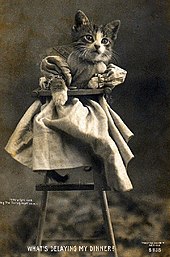
However, the most advanced research techniques (a few pints of beer) have allowed meme fragments to be scooped from these wild strains of LOLcat (Adviceanimalis lolfelis) and Chad (Chaddus quiznahilis). These fragments extracted were then recombined and spliced to produce the memetically modified chimaera: the LOLChad.
The was and the “WOT NO X?” phrasal templates have been retained from the chad, whereas the hands have become paws, while adapting the phemotypical traits of cats ears and nose and pupils. The variable, X, in the phrasal template also introduces the category selection restriction that it must be in relevant LOLspeak.
Some would argue that meddling with memetics is against nature: If Ceiling Cat wanted Mr Chad to have cats ears, he would have created it.
More pressing, however, are safety concerns. Such hybrids have not been shown to be risk-free, and until scientifically proven and should be confined to the laboratory.
The dangers have been highlighted in the documentary The Epidemic which shows the hazards of an outbreak of unmodified chads. Their cultural effects are unknown. It is also quite possible that these engineered variants would have a significantly higher basic reproduction rate (R0). Consequently, they could and pose a threat to the cultural ecology were they to be introduced into the wild.
Selection, variation and reproduction are the Darwinian essentials needed to produce a meme. Selection pressure for a piece of music can come from outside of the composer in the form of listener’s tastes and market factors. There is also selection pressure going on inside the composer’s mind before it gets onto manuscript or Digital Audio Workstation.
For me, the first hoop a tune has to jump through is that of being catchy. If some divine inspiration hits me and I get some musical idea, then the test is for it to stick with me for some time. When it can do that, then I know it is potential hook material and could well be the basis of a track.
It is then that the hard work begins. Turning a raw hook into a well-formed production. Well-formedness is a mathematical term. Basically, it means that an expression adheres to a formula, a syntax, by which it makes sense. Here, there are a bunch of criteria that the expression must meet to make it well-formed. In evolutionary terms, a morph or derived variant must also meet the criteria. Where it does, then it persists and could replicate (with variation) onto the next elimination round. The criteria it must meet constitute the selection pressure.
A “well-formed” piece of music, particularly one aimed at the popular market is faced with selection criteria. Highly experimental or avant-garde compositions have niche audiences. Contemporary pop of any sub-genre, on the other hand, follows a cluster of tropes and conventions. A genre is a classification, a boundary that defines the range of traits particular instances of that genre. Genres then, also provide a template for the musician and to write in that genre then a set of general criteria must be adhered to, but with some flexibility in the actual implementation in order to make it unique and fresh. Disregarding those constraints would make a piece seem too unusual to an audience to understand and listen too. The point of pop, and its dependent industries, is to go easy on the mind, something that doesn’t require much thinking about while listening to drive time radio, soaking up the advertising intermissions. Fortunately, for the composer, it is easier to compose within a familiar genre than it is to be radical. The downside is the often-heard lament that “all music sounds the same these days!”
So within the genres formulaic structures, tropes and conventions for well-formedness, we have selection pressure going on in the mind of the musician who aspires to popularity. As said, this is the hard work, as it often turns into an internal wrestling match over subtle, or not so subtle, nuances in order to get a piece to work. What are these boxes that have to be ticked? Well, listening to commercial radio for a while gives us a clue. It gives us an indication of what the listeners and radio station staff are used to and need. Going outside the familiar would confuse them so programming selects tracks for easy consumption.
Firstly, the standard pop song is around three and a half minutes at around 120bpm which does not overtax the attention span. Secondly, it is likely to be structured in the verse-chorus-verse-chorus-middle eight-chorus way, although there are variants, thirdly major keys and 4/4 patterns are popular in contemporary pop. These tend to be the standards.
Truth be told, sticking to that pattern is easy as cranking out unoriginal cliches is facile. Simply copying a tune is to do a cover version, but releasing it as your own material is a no-no, with copywrite ramifications. Yet audiences crave familiarity with some element of newness. Operating within bounded creativity is not so facile; it is about innovating something new and fresh while at the same time sticking to old conventions. Those two selection pressures are contradictory and the art is to be in the Goldy Locks zone between them. Culture goes in waves; musicians, producers and executives know this – particularly where being in that zone, in terms of commercial music, is their bread and butter.
But what are some factors that the song-writer considers, albeit at the unconscious level of mastery? As I have noted, inspiration is not the issue, turning that moment of magical encounter into a product that can attract radio air time, is the true craft here. It is ofter the case that a hook appears out of the blue: a strong riff and a memorable lyrical line originating from a maxim, or aphorism in our back-culture. Obviously, this hook would be a basis, but now needs to meet the other conditions to become a fully-fledged track fit for airplay. The rest of the song might not be furnished by the muses, and so the song-writer has to, somehow, fill in those gaps. A common approach is to put in some nonsense filler as lyrics, a kind of lorum ipsum that acts as a placeholder for later thinking while working on the melody. It could be meaningless gibberish that just fits the meter, or ‘Ohh, baby baby’ type crooning. Nowadays, topliners work over existing music beds. Once again such filler is insufficient to go to market, so deriving a proper song introduces a whole new set of poetic selection pressures.
Semantics comes into play. Often the hook has some meaning that sets the theme and develops into the narrative that the song conveys. Within this context, the lyrics have to support and make sense in progressing the narrative. There can be a jarring effect otherwise where a line is incoherent with the rest of the song. Furthermore, in pop, the words should also be easy to remember, easy to sing along too, and therefore not overy complicated nor cleaver.
A rhyming schema is not a necessity, but contemporary pop usually adopts such as it makes for better memorability and seems to make the result psychologically more satisfying.
The meter of the song is important as it gives it its feel. The rhythm of the wording, ideally, is consistent with the tun and with itself. Sticking lyrical elements over musical ones where they do not match tends not to work well.
The labour of the song-writer then is to meet with such selection pressures (among others). Frequently, for example, half of a verse may work well, but the rest just isn’t happening. It could be that it doesn’t fit sensibly with the story, or the rhyme is too strained, or words are repeated, or for many other reasons. Upon hitting this well-known writers’ block, the lyricist naturally starts to look for variations that might work: shuffling around or introducing new words in an attempt to generate some variant that does fit the bill. I’ve experienced that finding something better can interfere with other parts, or even derail the whole song forcing me to review the project and adapt those older parts that no longer fit the more promising line.
This process of churning possibilities and recombinations around in my head, flip-flopping around attractors and hill-climbing in bounded musical phase space can take weeks or months. Sometimes though, a breakthrough occurs: the line just feels right, it meets the selection criteria and can be admitted conditionally into the work. The final piece has taken a long Darwinian path from dream to demo, but it still has much further to go to get to the audience.