Cliology

Blog

  • Clio featuring Calliope

    Clio featuring Calliope

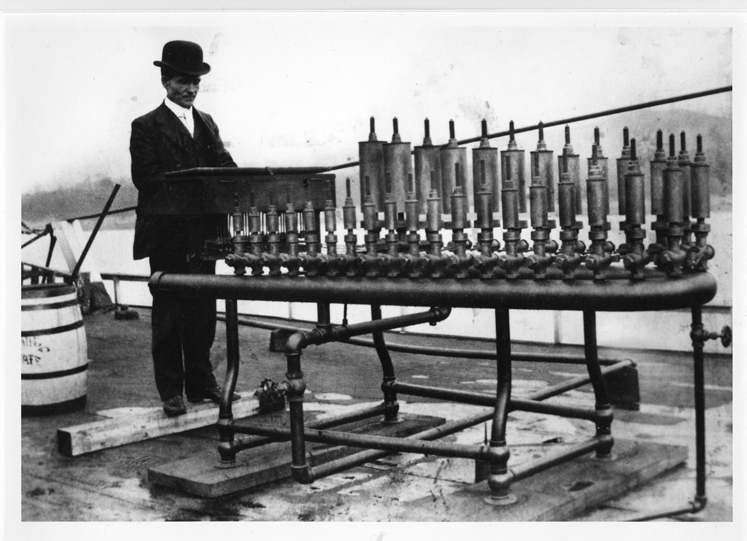
    This may be mixing the muses too far but I went to the Sheffield Synthfest over the weekend. It was a big room packed with geeks in referential T-shirts and lots of machines that go beep: heaven (17 that is). One stall, (synthevolution.net) was selling a poster charting all the old synths that I used to get booted out of music shops for messing with. I bought a mug featuring the Arp 2600: the voice of R2-D2. This raised a few thoughts as to the relationship between synthesizers and cliology.

    The synth evolution chart’s axes were arranged historically and alphabetically. I wondered what it would look like as a cliogram, that is: as a phylogenetic reconstruction of parameters and emerging technologies. Moreover, what would the gaps in the reconstruction show? What would it have been like if Casio had taken its phase distortion method more seriously rather than packaging it into Christmas presents? Would a cliogram indicate a potential future trajectory of music technology? I don’t know yet.

    The evolution of music technology

    A seminar by Martin Russ on the use of residuals, reminded me that one of the points of synthesis (although not the point of his talk) was to generate complexity from a limited set of parameters; a huge number of sounds from a small set of knobs and dials; a Mandelbrot set from a vector; an entire biodiversity from a few nucleotides. In a sense, a synthesiser patch is to the sound, as the genome is to the phenome of an organism. It is a simple code that is expressed as a complex entity. Now, resynthesis (which partially was the point of Martin’s talk) involves trying to analyse an original sound and imitate it using but the limitations built into a synth. Resynthesis can be thought of as a lossy CODEC, a code-decode algorithm that doesn’t quite recreate the original pattern but is a close enough approximation in a trade-off between fidelity and the specifying parameters. Essentially then, a synth patch is the DNA of the beeps and whooshes that come out of our loudspeakers.

    Slide from Martin Ware’s talk

    I’ve employed the term clioanalysis for the systematic examination and encoding of historical dynamics and culture, with a view to sticking these in a database for further processing. I have also used additive and subtractive synthesis as an analogy for model building and hypothesis generation; for transporting biological principles over the Heackelian bridge to inspire a scientific theory of culture. Up until now, even though I’ve got into the habit of sticking “clio-” in front of just about everything, the idea of cliosynthesis hadn’t dawned upon me. As the idea isn’t immediately objectionable, let’s explore it.

    Given the above perspective that analysis is the reduction and encoding of complexity into a few parameters, and synthesis is the reverse, then clioanalysis takes a cultural object and boils it down to an array of traits, or meme as I like to think. This codification of culture, in reducing it to binary, allows us to number crunch it, and spit out tree-like diagrams depicting cultural evolution. Cliosynthesis then would be the opposite process, of taking the code and turning it as some cultural object. This has the air of being a set of processes we are already familiar with, but under different names. Perhaps learning and behaviour might be words used by psychologists.

    But a new word is useful if it gives us a finer grained nuance. The idea of “clioanalysis” started life as reviewing some book (eg Nudge) and waffling on about any point salient to cliology. It has grown up a bit since then, and now it seems to be converging with the phenetic methods I used to draw evolutionary trees of cultural objects. It is showing itself to be an analogue of gene sequencing techniques. Cliosynthesis, on the other hand, seems to be converging with the more radical idea of Recombinant Meme Engineering (RME). This was conjured up as a parallel to genetic modification: the cleaving and splicing of meme fragments in order to create novel cultural forms, (eg. for product development, or corporate strategy.)

    Clioanalysis and cliosynthesis are perhaps further examples of words and meanings finding their soul mates. I still like to play with gadgets that go beep, but we should wonder about any box marked up as a cliosynthesiser.
  • Dawyk Gardens

    Dawyk Gardens

    I’m continuing my botanical Odyssey, which is inspiring my spirit of systematics. I’ve found myself in Edinburgh, Scotland, for some reason – I’ve been to Inverleith a couple of times, and this time I wanted to have a look at one of the other 3 Royal Botanic Garden sites. About 30 miles south of Edinburgh near Peebles, is the Dawyck gardens. This is more of an arborium, lots of trees (I like trees), which was formally the grounds of the estate of the Darwyck mansion set in the remote lowland hills of Tweedale.

    In contrast to my visit to Kew, its raining up here, north of the border. A far cry from London, where a jet groans through the air every 45 seconds on its descent into Heathrow. The air is so clean that lichen decorates nearly every tree branch. The grouse are foraging on a gently sloping lawn in the cool light Scottish drizzle. I’ve just taken a personalised guided tour of the grounds; personalised as the weather seems to have put everyone else off. Carol and Gavin were particularly knowledgeable, not just about the living collection, but also about the history of its collectors. If you ever visit, then it is worth taking the tour.

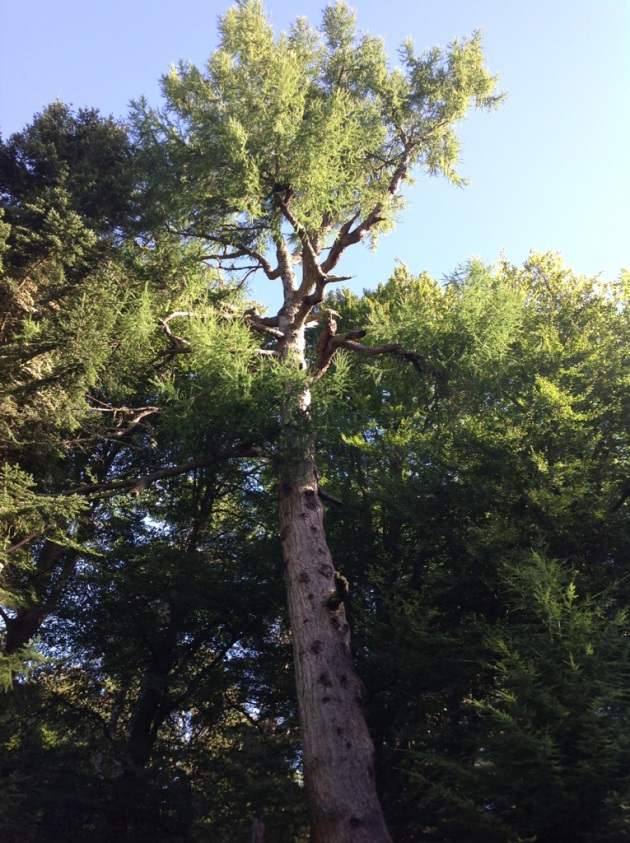
    I’ve put up a picture of a tree planted in 1750,  legend has it that Linnaeus planted it, but its been admitted that it was more likely one of Linnaeus’ students, Sir James Naesmyth.

    I’ve contemplated about the mind of the taxonomist in previous posts and it seems that there is some element of the mad victorian explorer being funded by eccentric super rich collectectors to impress their friends. Apparently the first to get hold of a new species was a status thing of imperial times. I guess I’m going to get more into that kind of history, and create a taxonomy of taxonomists. One of the guys though, was David Douglas who plundered north America for specimens, including the Douglas Fir. My thinking is about how this spirit of adventure can be applied to cataloguing specimens of clia, and building the meme-bank; I suppose some eccentricity would be involved along the way..

    Ah, another very British cup of tea; the grouse in the Scotch mist have now been joined by a rabbit.

  • Code breakers

    Code breakers

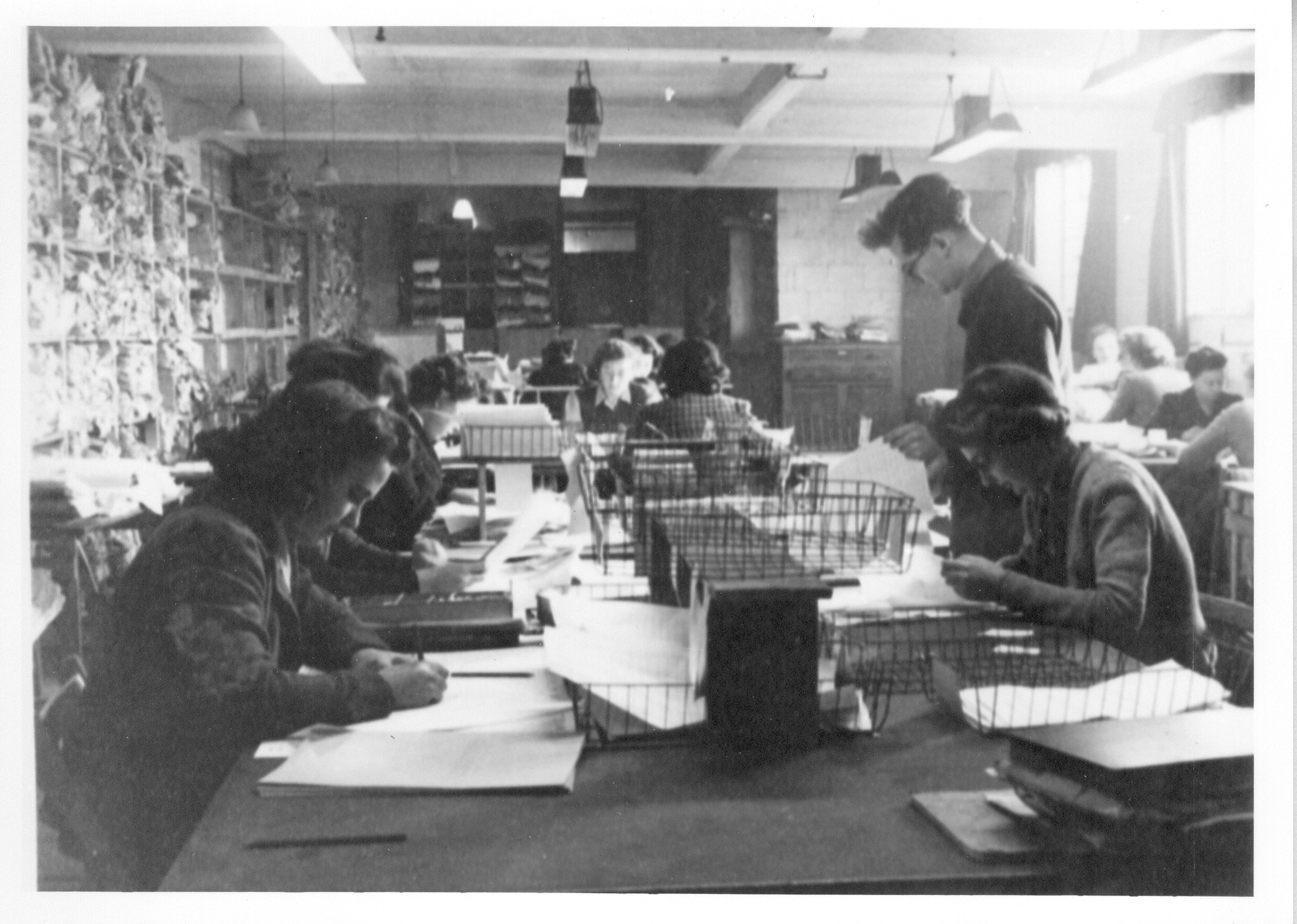
    I’m in the car-park at Bletchley Park, famed for Alan Turing, Tommy Flowers  (my hero), Collosus, one of the worlds first computers, the Enagma machine they used to crack the German secret codes during the second world war. I suppose its a kind of Hajj for any computer geek like me. What has this to do with cliology and memetics; probably not a lot, other than my having to hack into my own webpage account, but lets invent some connection and see how it pans out.

    Actually, first of all the German U boat plans were definatly not intended as a meme. The objectives of encryption is the opposite of memetics. It is intended to get to only the intended recipient, and absolutley no one else. On the other hand, there will always be those who want to find out what you don’t want them to know. So this is pointing to a big division in information: between the secret and the public. If secret information does get out, then it can  take on viral properties as scandle and outrage, so a meme it is; albeit one that is quarantined.

    Then we have memes at a higher level than the actual specific information. In securing the state (Ormond) the overall aims of defense and national security are generally well known. It is within this context that exposure of secret information might present an information hazard (Bostrom). That states have secrets and military plans is hardly a secret, even if the content is. From a memetic angle then “preserving our way of life” is a sign of cultural self-defense; a memeplex coevolved for mutual survival. So, the whole thing (ie state) has a vested interest in keeping secrets away from enermy eyes. Secret information itself might be a quarantined meme, which does not spread, but it is one that is guarded and essential to sustaining its co-memes. During the war, Nazi invasion plans threatened British culture; it was in the British interst to expose their plans, while hiding our own Operation Market Garden.

    On a differnt level, cryptography, secrecy, espionage, trade-craft, and conspiracy are all memeplexes of deception around signaling and screening games. Again, encription is no secret even if the contents are; you know I have a password on this site; we all know about the existence of GCHQ and NSA; of crypto-currency and PGP; of cyber attack and of virus protection. Indeed, proclaiming (and promoting) protection by reCAPTCHA is a web-site selling point.

    Memes rely on spreading for their survival, and so it would seem the more that become hosts would be a good thing from a meme’s eye view. This may not actually be the case though when viewed from the perspective of wider memeplexes. Restricting certain memes to the trusted few, allows for the preservation and spread of the wider memeplex. Without that secrecy, the wider memeplex becomes vulnerable to enermies, and insurgent memes seeking new brains to inhabit.

    Those are some wild inspirations coming from a visit to Bletchley Park. But this is a blog, so any unsubstantiated waffle is acceptable here.

  • The primicy of values as a memetic “mitochondria”

    The primicy of values as a memetic “mitochondria”

    I dont know if we have a metaphysical soul, or whether that is just a metaphor for a vast tangle of neurons. At some level we have needs and wants and in the noam model, I am taking the fundamental unit of analysis to be that of values. The definitions here are drawn from philosophy (axiology) and psychology, especially those elaborated by Milton Rokeach, and those that have been employed by clinical psychlogy. I’m sure the economic definitions overlap, but in the noam model of motivational narrimes, I’m trying to get to our core impetus, the things that drive us to action, our causes. In Acceptance and Commitment Therapy one of the things is to have commited action in the service of our values. In that sense, we behave according to what we think is important to us.

    Stimulus and response are familiar concepts to behaviourists: bell – slaver! The noam model introduces a third point of value to make a triangle. For higher thinking organisms the connection between stimulus and response is a bit more involved. When presented with a situation, a human will often consider the consequences of their action (albeit unconsciously) before responding. That anticipated cosequence is evaluated according to the agents value system. Is the outcome likely to be profitable, or an exercise in futility? Of course, in reality we are searching for the the best overall outcome from a range of potencial options, and the factors involved can be bewildering. Often it is not just a case of ‘what’s in it for me?’ but also of ethics, of enviromental concerns, of cost, of other people. To oversimplify, we summise all these value components, and chose the action that yeilds the greatest overall reward.

    Hence our values motivate our choice of behaviour; they also give motion to the notions and narratives that are expressed as culture. Metaphorically, values are memetic mitochondria: they power the flagella that propel the germplasm of ideation through society. They tell us what information to accept from others and what information to pass on to others. In an advertising situation of yesteryear for example, we might have gleamed that ‘Guiness is good for you’, if we were to believe that that beverage’s nutritional content was beneficial to our health (along with all the other factors such as taste and price and acceptance of alcohol), then we might be inclined to brand switch. If we achieved outstanding results and attributed it to the Guiness, and we knew our friends shared similar values, then we might further be inclined to recommend it, maybe even reciting the slogan. The Guiness brand would be a meme propagated as being ‘good for you’. The Holy Salvation meme has a similar modus operandi.

    Value systems themselves are also memes: they spread. Conservatism, liberalism, or socialism do not arise independently in the individual, but are adherited from the individual’s social milieu. Beck and Cowan refer to these wider worldviews, in Spiral Dynamics, as vmemes (value memes); they are cognitive gadgets (Hayes). It is within the framework of our incombant vmemes that we filter insurgent memes presented to us.

    In the noam model have denoted stimulus as sigma, response as rho, and values as nu, and will contemplate the triangular interrelationship between them, with respect to cliology, in later posts.

  • Triggered Part II

    Triggered Part II

    My previous posts have looked at how a meme consists of two noams, or behaviourally executable narrative elements.

    V)φ ∧ V)ψ = W)

    The phi-noam then is the functional component that can carry some action in response to a context, such as road safety, or washing your hands, or buying cleaning products, or worshiping God, or even suicide terrorism.

    V)φ = functional behaviour

    The behaviour is invoked through pattern matching the sigma stimuli according to the situation.

    σ → [ V)φ ] → ρ

    The other component, the psi-noam allows for the spread and replication of the meme.

    V)ψ = share this

    The psy-noam appears to operate on some similar stimulus-response to the phy-noam, except it is sigma stimulated by the opportunity to copy the meme invoking the rho response pattern of doing so. Most spectacular examples are evangelical Christians and MLM distributors who are trained to spot likely recruits. Those who like to tell you what they have bought recently, or what series they are watching might be less obvious examples, but it seems we all like to make recommendations when the relevant subject comes up in conversation.

    This phenomena first came to my attention while explaining to someone about what I was researching, and when I said ‘virus of the mind’, the person I was talking to started talking about a song by Heather Nova. Several months later, the same person asked me the same thing again, and when I replied, ‘virus of the mind’,  they repeated, almost verbatim, what they had said before, and the remaining conversation was earily familiar. I began to notice people trotting out their favorate anecdotes given the thread of conversation, and began to play with the idea that I could steer the conversation in a certain direction in order to get them to recant their set-piece. University Professors were the most prone to such cues, it would seem. It struck me that they were being triggered to respond in predictable ways, which is almost too much fun for a deviant social psychologist to resist toying with.

    An MLM distributor, for example, would prick up their ears should you reveal that you are in need of more money, and probably tell you about their ‘unique business opportunity you should look into’. I have been involved with such “opportunities”‘ and their training seminars condition distributors to listen out for need: this would be the sigma stimulus on the psy-noam, which would invoke the rho response of some prescripted patter. New recruits would then be trained to do the same. Hence, we can generalise the spreadable component of a meme as the triggered response:

    σ → [ V)ψ ] → ρ : invite the prospect to view the opportunity

    I will put the phy and psy components back together to assemble a complete meme in a future post.


  • Triggered Part I

    Triggered Part I

    OK, ‘triggered’ has a clinical definition as well as that of an overblown reaction based on hypersensitivity to a moral issue. More generally, triggering is evocation (maybe invocation or even provocation) of a response to some given stimulus. We can apply a memetic sense of a meme being triggered. From a rule governed behaviour perspective, experience would be a guide to dealing with a situation. The green cross code indoctrinated us with kerb drill, such that we automatically “stop, look, listen” for cars when we get to a kerb.  A memetic translation would be that we are hosts to road safety memes, on getting to a kerb, the functional part of the meme is triggered, and the behaviour of attention switching is invoked for avoiding large chunks of metal hrtleing around at alarming speeds. This is something which I forgot today and nearly got squashed; probably because there was no kerb to trigger the meme.

    I have said that a meme consists of two noams. The green cross code and the like is clearly a meme as it is not socially acceptable for children to learn about the dangers of the road in a directly Darwinian way. The psi-noam pertains to the spread and replication of hazard awareness. The phi-noam then is the functional component: the bit that keeps you alive.

    V)φ = functional behaviour of “stop-look-listen”

    V)ψ = share this

    V)φ ∧ V)ψ = W) = the green cross code meme

    Stimulus-response is usually associated with Skinner and Pavlov, and the idea of conditioning. However, this input-output is a cybernetic principle and can relate from a grasshopper jumping at a sound (reflex) to a presumably complex processes of the United Nations (resolution). Between input and output there is some process, however direct or intractably bureaucratic. The noam model maintains this cybernetic framework. It constituted by sigma, as stimuli pattern which is someway mapped to rho response pattern of action. Upon trapping a sigma pattern match, the noam is triggered therby invoking  the rho response pattern. So, in the example, spotting the kerb and the road (etc.) would pattern match the sigma of the phy-noam of the green cross code meme (such jargon eh!?) and invoke the stop-look-listen behaviour.

    σ → [ V)φ ] → ρ

    The noam/meme model is somewhat more involved than this, and I will have more to say about it in further posts, but that will do for now.

  • Meme Containers

    Meme Containers

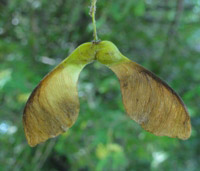
    I will define a container as being something that carries things. This is an abstract mathematical concept but one that allows us to think about the properties and relationships of such as hosts, parasites and memes. My guess is that a mathematician would want to treat them with some set theoretical or relational position, or a computer scientist might consider them a generic type in programming. I’d rather not stray too far down those paths. Instead, I’m trying to model the types of things that a thing can carry or not. The view is predominantly from an informatics perspective, particularly of code that encodes itself, like a meme or gene or other replicator, and can be used to model things like an organism’s life-cycle such as that of the sycamore tree: pollen, germ, spinning-jenny, dicotyledon, sapling, mature tree. Moreover, containers should allow us to model memes – ideas that contain their own replication drivers. However, I fancy the notion could include: shopping bags, boxes of goods transported in a truck, patient zero on a plane, and all kinds of fleas with lesser fleas. I will elaborate on this approach in later articles.

    So we have things that:

    {can carry, can be carried}

    which gives two boolean dimensions. If we expand this to consider the types of things that can be carried:Image result for spinning jenny sycamore

    {own-type, other-type},

    then that gives us three boolean dimensions:

    {can carry own-type, can carry other-type, can be carried by other-type}.

    Note that “can carry own-type” implies that can be carried by its own-type. Also, it is possible, in this treatment, to at once carry own and other type. So now we have a taxonomy of a phase-space of 8 possiblities of container, with an attempt at descriptive lables (these are for want of a better term and neither accurate nor definative), that can be depicted as a truth table:


    can be carried can carry other can carry self Type
    0 0 0 Mountain
    0 0 1 Matriovska
    0 1 0 Ship
    0 1 1 Host
    1 0 0 Gem
    1 0 1 Virus
    1 1 0 Hetro container
    1 1 1
    Universal container

    Of importance, epidemiologically are {host, virus, hetro-container, universal container}.

    Viruses are carried by a vector and contain their own information, but they do not transport other items.

    A host is examplified by a reservoir species. The host carries its own information, but can also carry that of other types, such as a virus.

    A hetro-container (HC) can be carried, can carry other items, but cannot carry itself. This is akin to product shipments allong the supply chain. A pallet woluld contain boxes, which would contain retail packaging, which would contain the actual goods. As a pure “set” like mathematical concept, a hetro-container might present Russelian grade paradoxes. It is included to complete the discussion of the phase-space, and also a warning of a potential mind-bender worthy of avoidance.

    A universal-container (UC) has all three properties and can carry anything that can be carried, including itself.

    For memetics humans are hosts, and we “contain”, or perhaps entertain, ideas. Ideas clearly can be carried (OK, so can humans, but we are in spherical cow space with this). Some of our thoughts are personal and do not spread, these would be “gems”; a gem, defined as something that can only be carried, can not carry itself, and so is sterile to replication. On the other hand, carriable ideas that can only carry theirselves would be pure replicators, without an effective payload. Like a chain letter such “viruses” would serve only to spread, but would have no other function. The “universal container” then would be an idea that contains itself (spreadable), but can also contain other, perhaps functional, ideas. From this basic taxonomy, we can  moves us towards a practical meme concept.

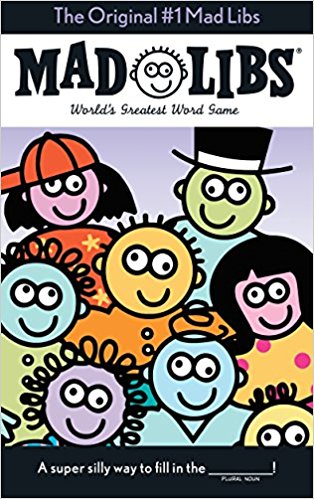
  • Mad-Libs: A super silly way to fill in the ___!

    Mad-Libs: A super silly way to fill in the ___!

    Another Amazon binge. Things will be coming through my letterbox for the next few days. This isn’t technically a book review but rather a review of a phrasal template word game book that gives insight into Recombinant Meme Engineering (RME), as tool for cliotechnology. 

    Mad-Libs bills itself as the world’s greatest word game which requires players to provide a list of words which are then inserted into a sentences. The result being some gramatically correct, but amusing story. Viewers of the BBC’s Have I Got News For You will be familair with their round where some words are blanked out from a news headline for the contestants fill in, usually with call back humor established earlier in the show. The effect can be surreal.

    The back cover gives an example (filled in blanks underlined):

    “Every morning before washing your cat, massage it gently with a/an doorknob that has been soaked overnight an a/an pencil box full of warm corn oil.”

    Hilarious. The comedic effect comes from violation of selection restrictions; such as doing something with something it is not meant to do. By throwing in arbetary words, the game deliberatly forces players to overcomes functional fixedness to generate giggle worthy nonsense.

    From a memetic perspective, the process adheres to grammar and innovates semantic content, which we can attempt to apprehend some meaning. However it clashes with our cultural understandings, derailing our tramlined notions and challenging our epsistemological memes. In releasing us from cognitive bias, then the game becomes an exploration of memetic phase space, allowing for memetic combinations that are hitherto unlikely given our mental funnels. The vast majority of the recombinations are inviable, or just plain silly; others do have potential for creativity and may lead to potentially danq new memes.

    Snow clones are a related concept, described by Geoffrey K. Pullum as “some-assembly-required adaptable cliché frames for lazy journalists.” These are often a popular phrase, possibly a quote from a film, or advert, whereby the key words are treated as variable but their relationships are preserved. These are adapted to the social context- they are very geeky and form the basis of many internet memes.

    “Brown is the new black” can be abstracted to

    “X is the new Y” and reinstantiated to such as

    “Snowclones are the new eggcorns

    Mad-libs thereby offers a tool for RME, and it is only a matter of time before their  automated software generation takes on a serious practical note.


  • Kew Gardens and Classification

    Kew Gardens and Classification

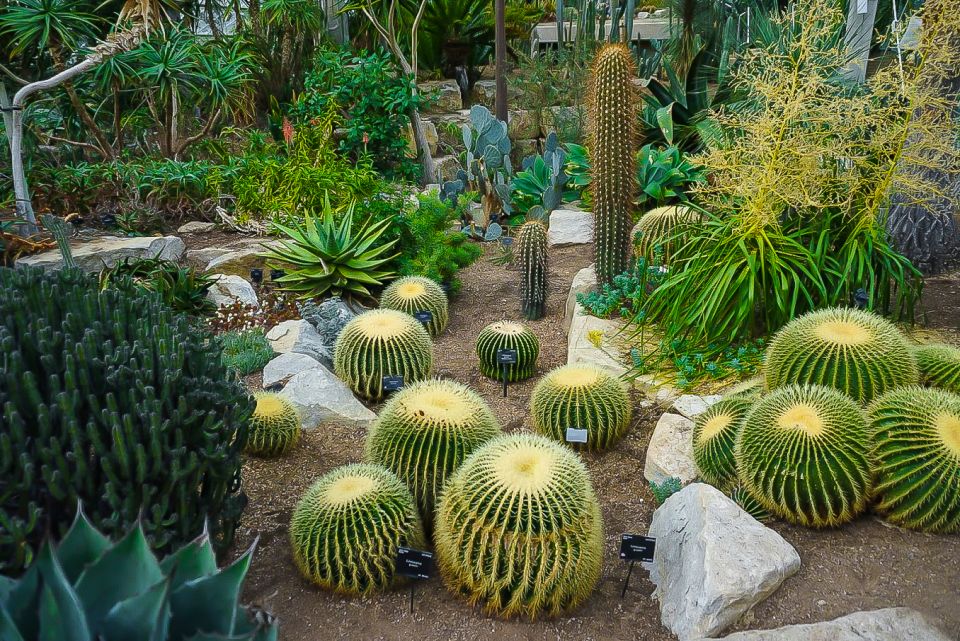
    I suppose one of the best places to understand biological classification is at a botanical gardens. I’m writing this post from the Royal Botanical Gardens at Kew in London. All the specimens in the collection have been classified and labelled up according to Linnaean systematics of course. These labels also include the rank of family, but go no higher. My guess is that specialists either know that already, or general familiy visitors enjoying the sunshine dont really care. I suppose the organisation of the collection in the gardens is for ease of understanding and curation, and those in the glass-houses are planted out according to their climate and location of origin – cactuses need hot and dry, ferns need it cool and wet, the carnivorous plants are put near the garbage bins.

    However, from a taxonomists point of view, the interesting aspect is to see an a large collection of specimens in the same place. Probably that serves some professional or psychological need. It gives a sense of scope of a genus (or whatever rank); it also beings out the urge to compare and contrast anatomical features and invokes scientific language – like, ‘oh, thats a funny looking fern, it looks like a mooses head!’

    I’ve been interested in these living collections since visiting Inverleith Botanical Gardens in Edinbourough aged about 10, which might explain a thing or two about my eventual academic direction. Of course, my focus is on Cultural Linnaeanism, and I’m seeking inspiration from the well established life-sciences. The learning point I’m getting right now sat in the cafe with a very English carton of tea (its actually hotter out here than in the cactus house) is that taxonomy is an engagement of the senses, to the fascination of the human doing it (science, sense; taxare L. to touch; specere L. to look) touching of the senses. I have a sense that variety is the spice here. Its a predisposition that perhaps evolutionary psychology might address.

    For culture, that might involve immersing oneself among a pile of roughly similar things, preferably real specimens collected together, a museum or gallery (cf clia), or a meeting of vintage car enthusiasts, or a department store, or even a real-ale festival! All that variey of things with similarities and differences! This way, the human side of the scientist’s musing comes out to play.

  • Marmite memes

    Marmite memes

    Marmite, you know how it goes “you love it or hate it.”   Its sticky; its spreadable; and that is exactly how a danq meme should be. Stickyness relates to the capacity of an idea to lodge in the mind; to be retained by its host until its triggering condition invokes its carrier to enact its expression. Spreadable means that a meme can be conveyed from one person to another with relative ease. That requires it to be easy to repeat by the sender and easy to absorbe by the recipient. Ambivalance towards a meme does not necessarily inhibit its spread, but one that does carry an emotional load, good or bad, can drive its host to relate it. This is somewhat similar to the way an advert that arouses strong feelings are more effective than bland feature dumps. So, the featues of a danq meme are that it is sticky spreadable and you eather love it or hate it. Just like marmite.