What makes for memeness?
Memes are a kind of idea. But what is it about them that warrants a new term, rather than just calling them ideas? Well, they have a set of properties specific to them that the more general concept of ideas do not necessarily share. Dawkins intended memes as a story-telling device to illustrate how genes are replicators. In doing so, he suggested that genes may not be the only class of replicator, but that communicated types of information may also be so. This gene-like information took on other Darwinian properties such as variation, reproduction, and selection and all that entailed. Memes then were “selfish” (in spite of lacking foresight) and were essentially in it for their own good and not that of their human hosts (although it raises the question of what it means to be human), hijacking human brains for their own propagation. The selfish-meme thereby became the “virus of the mind” or “thought contagion” view. A second strand was that culture is diffuse, varies and is subject to selection pressure. The meme then offered a candidate mechanism, a gene like replicator that is expressed as culture, thereby accounting for cultural evolution.
So then, to make the specific properties that differentiate a meme from other forms of idea (such as belief etc.) explicit. The three principle properties are variation, reproduction and selection, as suggested by Universal Darwinism. Dawkins had the properties of the meme as being longevity, fecundity and fidelity, although these reflect the Darwinian characteristics. Further memetic properties are offered from biology that can be inferred about their population ecology as agents operating in an environment of a community of human minds. Stories, narratives, jokes, are memes and suitable examples of the properties that memes possess. Some of the implications drawn about memes from biology are covered here.
Internet memes vs realmemetik
Most people nowadays think a meme is an annotated picture of a cat or some fail video where something goes horribly wrong. It is true that these are examples of memes but they are not the full picture. Memes are essentially any information that spreads socially, which then goes on to be expressed as that we call culture. Dawkins says:
“Examples of memes are tunes, ideas, catch-phrases, clothes fashions, ways of making pots or of building arches. Just as genes propagate themselves in the gene pool by leaping from body to body via sperms or eggs, so memes propagate themselves in the meme pool by leaping from brain to brain via a process which, in the broad sense, can be called imitation.” ― The Selfish Gene
Memes therefor can include religion, political ideology, language, the side of the road we drive on, fads, crazes, dance genres, methods of food production, taboos, laws, codes of conduct, routines, technology; they constitute much of what makes us distinctly human. Clearly, memes predate the internet, behavioural imitation whereby a skill that gives a benefit becomes more prevalent in a population probably predates even the development of language. It is simply that the internet is the agar of replicating information, making trivia easy and cheap to spread, that memes have become associated with it. Those frequently encountered visual joke formats shared across social media needed a name; they were memes, and so memes became them.
While providing spectacular examples of communicable tittle-tattle, those things called memes are a minuscule part of what memes are about. Perhaps it is because much of the culture we have lived with all our lives is so familiar and humdrum, that we fail to recognise them as memes. A distinction then needs making and this is the distinction between internet memes and real-memetik.
Internet memes are mostly innocuous, making us groan or chuckle, a tea break relief from day’s tension. Real-memetik, on the other hand, while mostly being about ambient culture, of QWERTY keyboards, 9-till-5 routines, and TV tropes, does have cases of critical impact to individuals, groups, organisations, society, and the planet as a whole. Market share and money may be involved, but so too are war, terrorism, climate change, even extinction.
Real-memetik has both parochial and global application, given a wider view of what memes are and how culture is influenceable. Internet memes, however, shouldn’t be dismissed just because they are seemingly trivial. Much can be gleamed by looking at internet memes principally because they do stand out as exemplars of highly contagious nonsense with little apparent value. They highlight the properties and dynamics that can be modelled out, and with this model, we can begin to manipulate the less obvious but more impactful memes that affect the world outside the internet.
Controversy
The real-memetik distinction is an attempt to prevent memetics from being trivialised. But even before internet memes absorbed the word meme, much academic controversy has plagued the development of memetics as both a science and as a useable tool. Much of this has focussed on the disanalogies between genes and memes and has arisen from misunderstandings of cultural emergence. Memes are not genes, but they have certain behavioural commonalities. Culture is not all in the genes, a problem that confused evolutionary psychology, but culture does have as Hayes says, a genetic starter kit. Culture does evolve but not in exactly the same way as biology. Many of the oppositions to memetics have been covered by Tim Tyler.
The problem with this controversy is twofold. Firstly, it has impeded a science of memes and secondly has held back a beneficial technology of memes. One source of objection comes from academic territorialism. Some evolutionary biologists claim evolution; some cultural anthropologists claim culture, and both reject whatever mongrel sits in the middle. But scent-marking aside, a big objection is that memetics has furnished no hard evidence and thereby does not warrant being accepted as a proper science. It’s true that memetics has been around nearing on 35 years yet has given rise to more pontification than empiricism from both meme evangelists and deniers alike. The problem seems to be more that engaging in argument that either memetics can’t be done, or that someone should do something about it is considerably easier than doing the work. This intellectual clog-up is compounded through lack of funding and the “penguin effect” whereby the first to jump into unknown waters risks their academic reputation and career. As an objection, saying memetics can’t be done because it hasn’t is clearly a fallacy. It is more likely that memetics isn’t being done and publicised more widely because no one wants to do the hard work given the hazards and lack of academic respectability (isn’t memes about cats?) A more serious impediment to memetics however is that terminological ambiguity and definitional dithering has made the field prone to confusion and misunderstanding and this lack of a solid basis has stalled rigorous investigation.
At best memetics is seen as a convenient metaphor, just a way of conveying a loose likeness between viruses and the spread of ideas. The benefits of the metaphor are seen but it also raises problems in itself. As a metaphorical thought vehicle, rather than some theory, memetics has no practical value. Furthermore, the “virus of the mind” trope has led some to think selfishness implies all memes are pathological bad ideas. Few consider memes to be something that can address real problems and so the whole idea is stuck in the dark ages.
One of the strangest fallacies is that if it could be done, it would have been; the corollary being that it hasn’t been done because it can’t. That memetics isn’t fully formed, and is in a bit of a state at the moment has led some to argue that memetics is a pseudoscience and therefore not worthy of pursuit. True, memetics has attracted wild speculation, quarrels, yet little empirical work, but it is somewhat ironic that those who advocate evolutionary theory demand that this shift in paradigm to have been fully formed to be of consideration: that is tantamount to creationism! No, the paradigm shift of memetics is itself evolutionary and it is still forming. We might see the bloom of speculation around memetics as being science fiction, or better still, a protoscience, a rigorous discipline in the making. Much might eventually be rejected as scientific selection pressure whittles down the unsubstantiable variations. But just because it hasn’t been done, simply means nothing more than it hasn’t been done yet.
Actual memetic engineering and cliology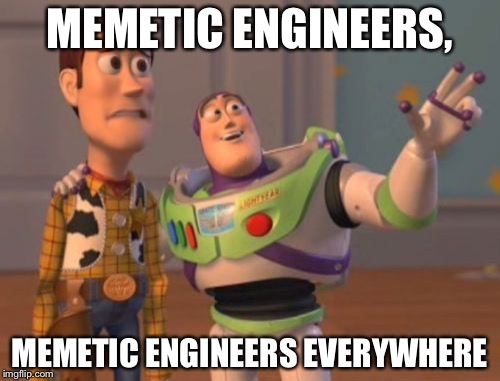
That memetics hasn’t transitioned from a proto-science to an established method of cultural intervention does not mean that it cannot. The reasons for non-uptake have nothing to do with culture being amenable to scientific scrutiny, or systematic design; they are merely a stumbling block borne out of a dominant worldview of intellectualising. In practice, a complete, coherent understanding is not necessary. Rather it is sufficient to have a model representative enough to get the desired results. The engineering direction is to figure out how to attain beneficial use out of some phenomenon, even if we can’t really explain it; the explanation will surely follow if the benefit turns out to be great enough.
In modern society, culture is inescapable, it is the cause and result of who we are and each of us is a corpusul who exert some influence. Social problems are real, and there is a clear need to address them. Taking an engineering interventionist mindset, the memetic model is sufficient to start to approach such problems more systematically. A complete understanding of social dynamics would be the ideal, but we just don’t have it yet, and it is unlikely to be forthcoming in light of the academic fillibusters. Without being too alarmist, we need to take action as soon as the time and tide of potential global catastrophes are becoming somewhat pressing. We need to up our game and leapfrog the dilly-dally.
The terms real-memetik, cliology (along with other neologisms and loan-terms) are introduced to differentiate between older less defined labels and well-formed definitions that give more precision in meaning. They also offer a bypass from the theoretical impasse by presenting a means of modelling cultural systems with an engineering eye. Real-memetik, as noted, is intended to suggest that internet in-jokes are by no means all there is to memes and that there are decidedly non-trivial implications that need urgent practical solutions. Cliology could well be synonymous with memetic engineering but has been adopted to quarantine its principles from the semantic contamination and confusion that has built up around present notions. A clean break also allows for more precision and scoping of the practice, and about the methods and technologies that might be employed.
The point of cliology (or memetic engineering or whatever) then, is somewhat JFDI, or rather, an engineering orientation of being solution centred. Fully formed and correct theory is not so much a concern as engineering models are more suited to the task. With this pragmatic shift in mindset, it becomes possible to reap the benefits of the memetic view without really worrying too much about whether memes “really” exist. The proof of this pudding is not in knowing how evolution selected nutritional reinforcements, but what the end results taste like. The criterion of engineering is to get something to work, post-rational explanations might then serve to get it working even better. For cliology then, models such as memetics are sufficient for building prototype methods of cultural intervention. If cliology demonstrates that it can alleviate at least some problems, then that might jump-start a programme that has been stalled intellectually.
Speculation on memetics
Speculation, however crazy it seems right now, is critical at this formative time. Cliology is about cultural engineering over a range of scopes and is currently thought to be principled on memetics. However, there are many areas of memetics that are not necessarily directed toward cultural intervention and change. Subsidiary topics on memetics may include (and will eventually be covered on their own pages on this site):
- The contextual behavioural science of the meme: which examines how memes interact with and affect individuals and organisations. This area automatically overlaps with psychology, sociology and cognitive science and can be considered as an empirical approach to studying memetics.
- phenomenology of the meme: a more philosophical approach could be applied to understanding how we experience memes. That is considering our thinking and actions and ideas as being memetic phenomena, and embracing the “memes eye view”. This leap in meta-cognition, as to who is doing the thinking and deciding (us or our memes), challenges what it means to be human by posing the prospect that we extend beyond individual Homo sapiens organisms: we humans are also our memes.
- personal memetics: that some memes are probiotically beneficial to the organism while others are maladaptive dysbiotic parasites leads to the principle of acquiring “good” memes and eliminating “bad” ones. Of course, the conundrum arises from knowing what constitutes “good” and “bad”, assessing the merits of a meme, and having a method of acquisition and elimination. Part of the issue stems from the problem of what it means to be human and who is doing the deciding. Epistemological memes operating on a higher level are implicated in the selection process. Thinking in terms of mindfulness, cognitive gadgets, pan-critical rationalism and so on gives insight into approaches to personal development, education & therapy such as Blackmore’s idea of meme weeding. We are all spreading and taking onboard memes all the time – the core idea here is that when we are doing so, when we are telling them some anecdote, or listening to their recommendations, then what is going on in our own minds.
- organisational memetics: wider social structures are held together by memes and the adherents to those memes. Understanding how organisations function from a memetic perspective, allows for the cultivation of eusocial structures, and the elimination of maladaptive cultural practices. The scope can range from the small enterprise, through large corporations, though to wider cultural implications.
- applied computational memetics: a meme is information, but information with a special trait of replication that gives rise to evolutionary implications. Being information, then it is amenable to the scrutiny of information science, and furthermore to computational representation and manipulation. Applied computational memetic then would see software and algorithms for identifying memes and tracking their flow-through information networks such as organisations or the world wide web.
- applied memetics: applying memetics to real-world problems is almost a synonym for cliology and would encompass all the above concerns. The slight difference between applied memetics and cliology is that of focus, although there is a major overlap. While memetics is essentially meme oriented and offers memetic explanations for socio-cultural phenomena, cliology is explicitly engineering-driven with the aim of providing cultural forecasting and intervention; it does not necessarily have to employ memes but does so as a matter of convenience.
- other aspects that need elaborating

- The development from a protoscience into a proper science
- language, selfish signifier, cumulative development, group selection
- memes in mind, memes in matter, memes in motion- blueprints and expression
- alpha and beta taxonomy- meme mapping and modelling, clionomy, cliology
- applications for understanding and for medelling: PR, advertising etc. hypervirulence
- model numbers, product innovation eka-space and technology
- narremes, carriers payload: a model of a meme – noam
- The development from a protoscience into a proper science