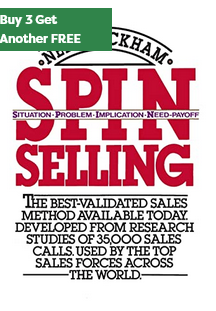
Neil Rackman 1988, McGraw-Hill Inc.
It is a truism that we (particularly the IT crowd) never get around to working on our own websites. This one has been down for over a year a) because I had to fix the underlying database and moreover b) I didn’t get around to it. So, now that there is at least some presence, then I can reboot banging out the content.
Part of my aspiration was to review the “cliobibliography”: literature related to memetic engineering. I’ve read, or rather part read, tons since the site got moofed, and so I’ll kick off on that trajectory – that might give me a bit of momentum. I originally wanted to do really in-depth reviews of the key literature, but that wasn’t working; I was aiming at perfectionism, and perfectionism is the killer. I’ll reign in the aspirations a bit and restructure these reviews to blog length or thereabouts.
—-
The applications of cliology are diverse as its origins. Parts of the framework are suitable for the arena what I cluster as: sales, promotions, advertising & marketing (SPAM). I have been involved with sales, but the more general principle of persuasion and influence, and the extrapolation to the wider cultural change level, are what fascinate me here.
SPIN selling is one of those books on how to be better at sales; a large hungry market. Of course, there are piles of books on this subject of varying quality, so why is SPIN selling worthy of review in the cliological context?
Firstly, its about big sales, like jumbo jets and nuclear reactors, which take a bit more effort than flogging cheap hookie and, accordingly, demand a different focus. Secondly, SPIN selling presents a rather different structure to more traditional sales training. What impresses me is that it is, at the same time, a practical system, while having academic rigour (“pracademic” maybe?)
Of course SPIN is an proprietary acronym set to the main principles. Acronyms are nothing new for sales and I was expecting it to be yet another pet mnemonic for keeping field agents focussed. Obviously SPIN (Situation, Problem, Implication and Need-payoff) does offer a way of memorising the key stages, but the whole thing goes much deeper, is more coherent, and has been developed with more scientific rigour than any other sales system I have encountered. Furthermore, the final chapter, Turning Theory Into Practice, really appeals to the practitioner in me as it’s actually about doing stuff and getting results, and that’s what any field sales reps wants: entelechy as Rackham reminds us.
However, what gets me, and something that would likely turn sales reps off (if it was written in pure academese) is that I sense much behavioural psychology theory combined with hard empirical research here.
The publishers naturally pitch SPIN selling to its target audience of hungry sales people. If I know sales folk well, they would want to run off excitedly into the field and try out their new skills even before reaching the end of the book. But the title is something of a misnomer: it isn’t “spin” at all, it’s not hype and hot air. There is actual methodology here and it is the appendix that sells to the academic in me.
Often sales can get wrapped up in zealous ra-ra-ra, totally ignoring the need for results. But Rackham goes all sober and clinical by asking whether or not this stuff actually stands up to evidence, or is it “snake oil”; a highly unusual glimpse of self-awareness. The soft sciences are notoriously confounded by variables that are difficult to control for. Rackham tackles these in depth, even taking his evaluation to the point of using Popperian falsifiability; and in withstanding that test (or, for that matter, even considering such), presents a more convincing case. Throughout reading, I was asking myself whether the Hawthorne Effect might have entered into the equation, and surprisingly (and to my delight), my concern had been addressed. OK, SPIN selling could be subject to more methodological scrutiny, but it went way more into proving its mettle than just about any other book of its genre. The book is from 1988 so it is unlikely that it would have met Contextual Behavioural Science that was emerging in the 1990s: a connection that would seem obvious today. It is solid material.
My concern, in these reviews, is how other models inform cliology. The cliological frameworks were never intended for the fly-by-the-seat-of-your-pants world of field sales: they are too cumbersome and involved for that. Yet, and likely attributable to some cognitive bias of mine, the underlying notions of SPIN selling are very much in alignment with cliology, and so cliology has the opportunity to learn. While sales may seem to be about flogging stuff, it can be seen more generally as a form of influence and therefore as an information transaction. Just about every time we open our mouths, we are, in some way, making a sale. I am to admit that, even here, I am selling the idea of cliology to the reader. The flow of the very memes that are expressed as culture, are the result of, sensu lato, sales. So, without fully elaborating the SPIN model, let’s exemplify by putting Rackham into practice.
The problem facing cliology is the effective intended social diffusion of ideas; the implications of not finding these being the cultural maladaptations I have harped on about elsewhere. So then, the needs-payoff is that cliology cries out for the explicit need of more effective and robust models for engineering and propagating memes. SPIN Selling, proposes such a model, and so benefits cliology: I’m sold; it’s a done deal!
It is hardly accidental that SPIN selling relates to the FABULA framework, as the latter was my respray of the idea of FAB selling (Features, Attributes and Benefits). While the FABULA framework is perhaps too detailed for field sales, SPIN does augment the theoretical model by providing practical and systematic methods of interaction and investigation. Another elaborate cliological framework is that of the COBRA model which maps onto The Value Equation – “is the problem big enough to justify this solution” (Rackham, p61) – noting that customers are more likely to apply the thinking-fast retronym of “Could One Be Really Arsed?” Again, there is a covariance between models that highlights Benefits (which meet an explicit need, rather than inviting knee-jerk objections through stating Advantages, which cover implied needs) is something the COBRA framework will embrace.
Of course, I’m going to have a think about all this, but in the meantime I’m going to run out excitedly and try out my new found selling skills.