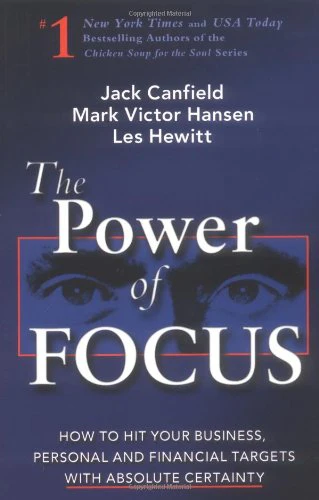
Jack Cranfield, Mark Victor Hansen, Les Hewitt
Cranfield J., Hansen M. V., Hewitt L. (2001) The Power Of Focus Vermillion: London
It is fair to review the Power of Focus in the light of having finished the 5am Club and embarking on its 66 day challenge. This book, among many others, has been languishing on my bookshelves for years, waiting for me to get around to reading it. The line about not being time management, but rather, focus management in the 5am Club gave me the impetus to pick it up. I can reaffirm Sharmer’s assertion and my conclusion that 5ac is a signpost of inspiration to deeper dives. The Power of Focus (2001) emphasises many points in 5ac and so becomes worthy of review. Furthermore, the chapter on asking for what you want, leads directly to the book I am currently reading and will be subsequently reviewing: Ask for More by Alexandra Carter (2021).
The Power of Focus does have an appropriate title as a success guide to both business and personal life and the necessary balance between. Its chapters cover ten strategies each with exercises and action steps with blank spaces to write in (which I never use).
- The first chapter on habits looks at the identification of the behaviours that are holding you back, the ones that will lead to success, and an action plan for their installation. The rest of the book revolves around the formation of habits within a general cluster of areas: confidence, relationships, asking, and so on. The authors claim “It works because it is simple”; perhaps too simple though? In the popular domain The Sweet Spot (Christine Carter, 2015) adds some psychology and neuroscience to the subject, while Shermer (XXXX) provides a 66 day timeframe to habit automation – however behavioural change is quite well examined in academic psychology and psychotherapy. A profound nugget of advice is ‘develop the habit of changing your habits’; a meta-habit to be sure. Unfortunately, cultivating the meta-habit needed a little more elaboration, and not just anecdotes.
- As per the title of the book, this chapter is about prioritising focus: finding, and concentrating practice on what you are brilliant at, while learning to let go of the distracting chores the build up like plaque. The idea of focus management (mentioned by Shermer) is the reason why I picked up this book, and so recently I have been focusing on focussing (yet another meta-habit). Mark Forster’s Do It Tomorrow (2014) system says that prioritising by importance is all wrong: if it isn’t important, don’t do it! So the idea is to develop some apprehension of what is propelling you forward, as opposed to just looking busy. Doing so enables you to set boundaries, then dumping or delegating the existing garbage, while saying “no” to incoming junk. I have adopted a system of tiers whereby I do the stuff I’m good at, want to do, and only while my mind is fresh in the morning: at least that gives me at least a few micro-wins. As I don’t really have the resources to delegate that which I can’t dump, then I schedule the tier of chores (financial, legal, domestic) for the afternoon so that they don’t eat into my real work time and grind me down before I even get going. I now consider such chore-like activities as simply affording clearance to the real work. I’ve found strictly partitioning my time according to what is delegatable (even if not actually delegated) to be of value, especially where I’m at a loss for what to do next in the real work. Instead of occupying myself with something trivial, but still needs doing (as per my social conditioning), I now instead contemplate what my next glorious achievement will be.
- With a habit of focus, then you need something worthwhile and important to focus upon, a crystal clear vision of what you want: goals. Personal success and management books are replete with proprietary goal setting acronyms and checklists (I’ll refrain from airing my own model here) and the power of focus present yet another (10 points in their list). They claim that ‘a goal without a number is just a slogan’. OK, without quantification, then the intention may not be a goal as commonly understood. But I would be reluctant to assign numerical values to everything, as that would preclude aspirations and quests, which necessitate an emotive quality that is beyond measure. Aside from that though, becoming ever more specific about your intention reduces the bigger picture into more manageable and actionable steps. There are a bunch of steps in creating this master plan, including prioritising what to do with a draw sheet; visualisation, forming mastermind groups, and using the “achievers focussing system” which covers several business and life areas (over a time period of 60 day plan).
- Having the discovered and prioritised goals, then their achievement requires the optimum balance of behaviours. The point is to cultivate a healthy lifestyle, rather than burnout in chasing superficial achievements, by both doing work that you love while living a life you love. As a guide to such balance, the authors provide a well-balanced set of things you should engage in each day. Their B-Alert system (yes, another mnemonic) stands for Blueprint (a daily plan that schedules the rest), Action, Learning, Exercise, Relaxation, & Thinking. The habit here then is in developing a well rounded day in all areas of personal development.
- While success is self-driven, we still live in a social world, and as a consequence, that success is influenced by the quality of our relationships and how we manage them. Developing an understanding of where prior relationships have flourished or failed, and the factors involved, gives insight into how to manage future relationships. Firstly, the authors recommend saying “no” to toxic people, and asking yourself, as Warren Buffet does: “Do I like them? Do I trust them? Do I respect them?” Tips are given for developing mentors and mastermind groups.
- Confidence is also a practice and habit, and the antidote to fear. Fear and avoidance are implicated in unfinished business, which becomes a vicious circle, leading to becoming trapped and stuck: make a habit of “stepping into fear”, resolve the issue, and then move on. A means of moving on is forgiving and forgetting, which is more about letting go (like the Sedona method), rather than adopting a victim mentality. To forgive and forget requires the confidence to take responsibility; it is about winning back your own power (blame just hands power over to others). In doing so, you are acting in your own interest as holding grudges is holding you back. Some strategies are given to help you build the winning attitude as well as what to do when you hit the inevitable slump.
- Given success has a social dimension of relationships, then that success often involves asking things of others. The ability to ask involves confidence and overcoming the fear of rejection. As a book like the Power of Focus is likely to attract sales people, then much of this strategy is focused on asking for business (endorsements, referrals etc). However, cultivating the essential habit of asking is generalisable (and leads directly to a forthcoming review I’m doing Ask For More by Alexandra Carter, 2021).
- A point reflected in Feel the Fear and Do it Anyway (1987) is that you don’t have to do anything, but rather choose to: it is consequentialism at a philosophical level, but also reflective of your own values and priorities by which to make more informed decisions. The point then is to make wiser choices that you can consistently and persistently stick to and ditch the distracting, emotionally draining things that clutter up your life. Given those preferential choices then, integrity in delivering what you have promised in your agreements, comes from having accountability. This chapter has the best cartoon, which the authors admit has absolutely no relevance.
- Taking decisive action: People procrastinate for their own reasons, the authors enumerate six for self-examination, leading to the notion that motivation comes either from fearing the consequences of inaction or getting excited about the benefits of proaction. They present another mnemonic: TADA (Think, Ask Decide, Act) which has slight similarities to the Demming cycle and the OODA loops of John Boyd. Because of the intended readership, much of the rest of this chapter is devoted to business and wealth. They skim the surface; NLP does a much stronger job of decision making and action strategies, and Robbins (1992) is notorious for this point.
- Living on purpose: Notwithstanding existential philosophy, ‘the meaning of life is to give life a meaning’ (attributed to many from Buddha onwards). The essence of all the strategies presented in this book then, are as tools in the striving towards our purposes in life. To me, this chapter is probably of utmost fundamental importance. It is about discovering your purpose and aligning your natural skills with determination and humbleness. The authors’ ladder of levels of being suggests that money and work and lifestyle are not the everything of life; rather success and failure are determined by levels of being. However, the scope of their model is hardly Maslow, nor Buddhism. They differentiate their statement of purpose from those empty corporate mission statements and do indicate that an individual’s sense of purpose can be developed. However, to me any statement of purpose is self-limiting. It may be a good start to get over spending energy on immediate surface goals, but like the tao, purpose can only be known when the training wheels of words can be dropped.
The Power of Focus has got a light hearted feel, and has plenty of amusing cartoons. Much is to be found from other success coaches and other personal development gurus, but, reimprinting foundational personal development ideas using different words, helps to cement them in.
American success book (kind of aimed at the stereotype insurance salesman) and so has the requisite biogs of sporting heroes.