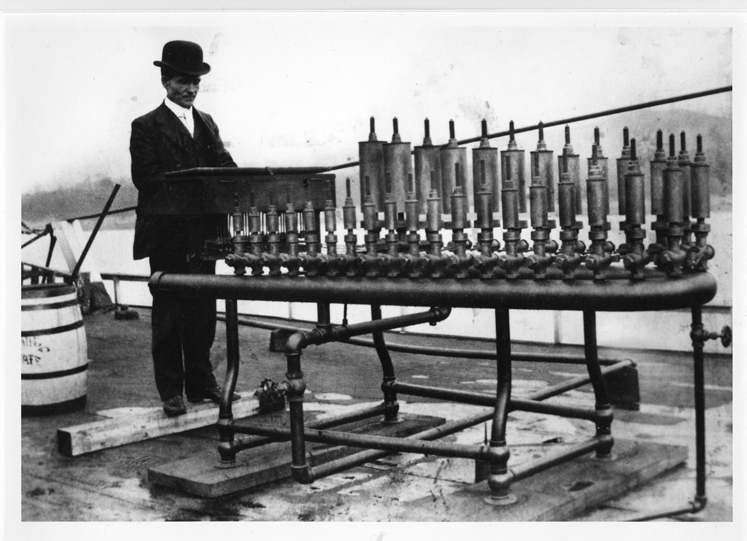
This may be mixing the muses too far but I went to the Sheffield Synthfest over the weekend. It was a big room packed with geeks in referential T-shirts and lots of machines that go beep: heaven (17 that is). One stall, (synthevolution.net) was selling a poster charting all the old synths that I used to get booted out of music shops for messing with. I bought a mug featuring the Arp 2600: the voice of R2-D2. This raised a few thoughts as to the relationship between synthesizers and cliology.
The synth evolution chart’s axes were arranged historically and alphabetically. I wondered what it would look like as a cliogram, that is: as a phylogenetic reconstruction of parameters and emerging technologies. Moreover, what would the gaps in the reconstruction show? What would it have been like if Casio had taken its phase distortion method more seriously rather than packaging it into Christmas presents? Would a cliogram indicate a potential future trajectory of music technology? I don’t know yet.

A seminar by Martin Russ on the use of residuals, reminded me that one of the points of synthesis (although not the point of his talk) was to generate complexity from a limited set of parameters; a huge number of sounds from a small set of knobs and dials; a Mandelbrot set from a vector; an entire biodiversity from a few nucleotides. In a sense, a synthesiser patch is to the sound, as the genome is to the phenome of an organism. It is a simple code that is expressed as a complex entity. Now, resynthesis (which partially was the point of Martin’s talk) involves trying to analyse an original sound and imitate it using but the limitations built into a synth. Resynthesis can be thought of as a lossy CODEC, a code-decode algorithm that doesn’t quite recreate the original pattern but is a close enough approximation in a trade-off between fidelity and the specifying parameters. Essentially then, a synth patch is the DNA of the beeps and whooshes that come out of our loudspeakers.

I’ve employed the term clioanalysis for the systematic examination and encoding of historical dynamics and culture, with a view to sticking these in a database for further processing. I have also used additive and subtractive synthesis as an analogy for model building and hypothesis generation; for transporting biological principles over the Heackelian bridge to inspire a scientific theory of culture. Up until now, even though I’ve got into the habit of sticking “clio-” in front of just about everything, the idea of cliosynthesis hadn’t dawned upon me. As the idea isn’t immediately objectionable, let’s explore it.
Given the above perspective that analysis is the reduction and encoding of complexity into a few parameters, and synthesis is the reverse, then clioanalysis takes a cultural object and boils it down to an array of traits, or meme as I like to think. This codification of culture, in reducing it to binary, allows us to number crunch it, and spit out tree-like diagrams depicting cultural evolution. Cliosynthesis then would be the opposite process, of taking the code and turning it as some cultural object. This has the air of being a set of processes we are already familiar with, but under different names. Perhaps learning and behaviour might be words used by psychologists.
But a new word is useful if it gives us a finer grained nuance. The idea of “clioanalysis” started life as reviewing some book (eg Nudge) and waffling on about any point salient to cliology. It has grown up a bit since then, and now it seems to be converging with the phenetic methods I used to draw evolutionary trees of cultural objects. It is showing itself to be an analogue of gene sequencing techniques. Cliosynthesis, on the other hand, seems to be converging with the more radical idea of Recombinant Meme Engineering (RME). This was conjured up as a parallel to genetic modification: the cleaving and splicing of meme fragments in order to create novel cultural forms, (eg. for product development, or corporate strategy.)
Clioanalysis and cliosynthesis are perhaps further examples of words and meanings finding their soul mates. I still like to play with gadgets that go beep, but we should wonder about any box marked up as a cliosynthesiser.
Leave a Reply