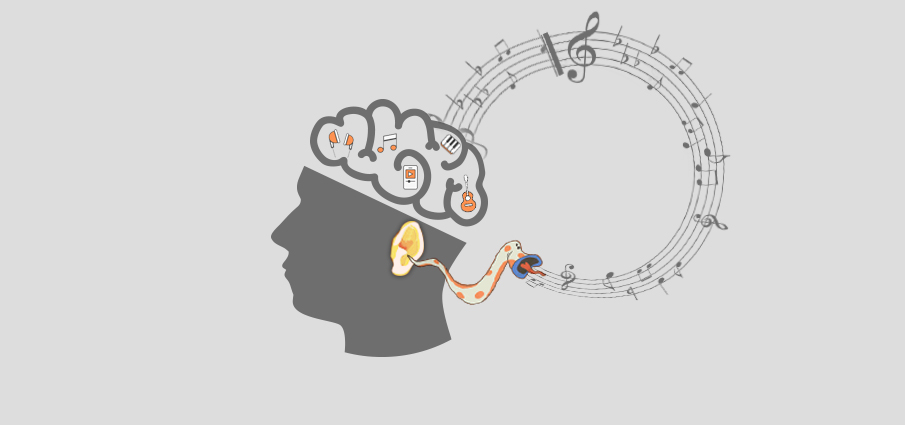
There are a multitude of ways of coming up with a song. Instrumentalists are likely to play what they are familiar with. A trained pianist is likely to plonk out some chords initially; a guitarist might do a bit of strumming. On the other hand, a vocalist might top-line over a track in an attempt to get that killer hook.
Another way is to avoid any means of producing a sound and go acapella. Acapella usually means vocal music without instrumental accompaniment, but Jason Blume suggests that it can also be about composing in the head. This is the mode that my earworm experiments take. This way it is not constrained bt the instrument nor the musician’s skill. Moreover, an earworm, as a tune that is difficult to dislodge from the mind’s ear, naturally resides in the mind, and so the head is the environment suited to its emergence.
Evolutionary epistemology is a good way of viewing the process. Contained entirely as mental processes, a kind of mental singing to ones-self, the fundamental evolutionary algorithm of blind-variation-and-selective-retention can be very agile in driving the development of a musical idea. Whether the source of variation is blind or divinely inspired or whatnot is another question. I have found that rolling a lyric I’ve made up around my mind tends to attract variants anyway.
Selection pressure could be about the tunes I like. Maybe on a neurological level this could be the case, but really selection is about a tune or lyric that persists – even if I don’t like it on some high-brow intellectual level. A tune that sticks is one I tend to, or rather cannot help but, dwell upon. I’ve now adopted the principle that a sticky tune should be kept, rather than trying to suppress it in favour of something cleaver, sophisticated or technical. Aligning such selection pressures is much more conducive to making earworms, and eases the frustration of intellectual dischord.
With a tune that is persistent and a natural tendency to play with variations then there is the basic agar of memetic music. Where a piece has some variation introduced and that variation is “fitter” then it survives the selection pressure and goes onto the next round of endurance. Being fitter means that the variation now becomes that which I can’t shift from my mind, thereby becoming the new basis for further variations.
From a muse inspired germ of an idea, the opus progresses entirely a capella and, should it prove unable to be gagged, then it becomes a candidate for actual production work. In reality, the process is a bit messier than this simplified account of the early stages of production and I will detail them as they become clearer.
Leave a Reply