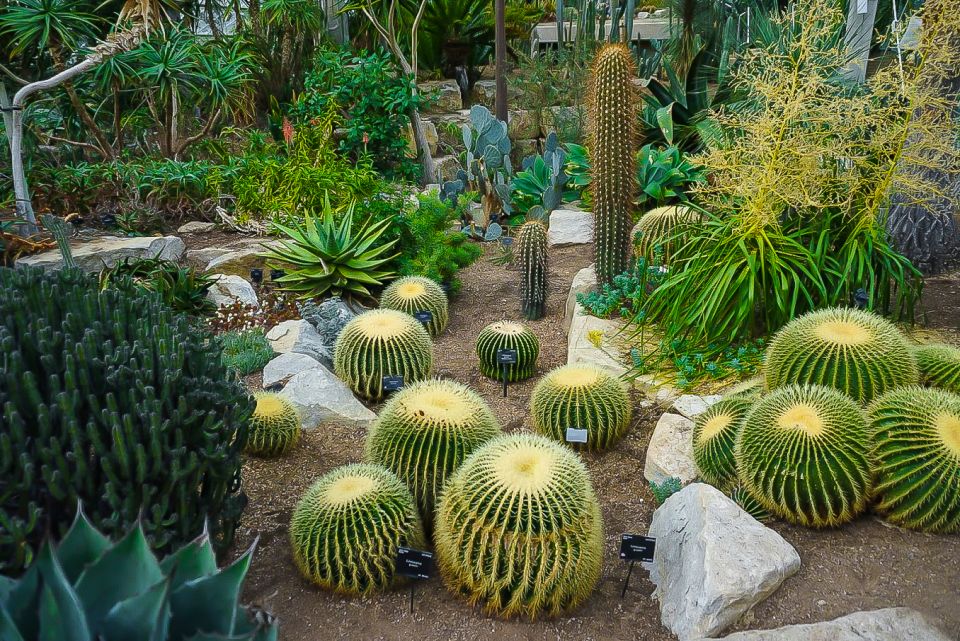
I suppose one of the best places to understand biological classification is at a botanical gardens. I’m writing this post from the Royal Botanical Gardens at Kew in London. All the specimens in the collection have been classified and labelled up according to Linnaean systematics of course. These labels also include the rank of family, but go no higher. My guess is that specialists either know that already, or general familiy visitors enjoying the sunshine dont really care. I suppose the organisation of the collection in the gardens is for ease of understanding and curation, and those in the glass-houses are planted out according to their climate and location of origin – cactuses need hot and dry, ferns need it cool and wet, the carnivorous plants are put near the garbage bins.
However, from a taxonomists point of view, the interesting aspect is to see an a large collection of specimens in the same place. Probably that serves some professional or psychological need. It gives a sense of scope of a genus (or whatever rank); it also beings out the urge to compare and contrast anatomical features and invokes scientific language – like, ‘oh, thats a funny looking fern, it looks like a mooses head!’
I’ve been interested in these living collections since visiting Inverleith Botanical Gardens in Edinbourough aged about 10, which might explain a thing or two about my eventual academic direction. Of course, my focus is on Cultural Linnaeanism, and I’m seeking inspiration from the well established life-sciences. The learning point I’m getting right now sat in the cafe with a very English carton of tea (its actually hotter out here than in the cactus house) is that taxonomy is an engagement of the senses, to the fascination of the human doing it (science, sense; taxare L. to touch; specere L. to look) touching of the senses. I have a sense that variety is the spice here. Its a predisposition that perhaps evolutionary psychology might address.
For culture, that might involve immersing oneself among a pile of roughly similar things, preferably real specimens collected together, a museum or gallery (cf clia), or a meeting of vintage car enthusiasts, or a department store, or even a real-ale festival! All that variey of things with similarities and differences! This way, the human side of the scientist’s musing comes out to play.
Leave a Reply