 The term “rabbit hole” is taken from Lewis Caroll’s Alice’s Adventures in Wonderland. where Alice chases the White Rabbit into a strange world. “Rabbit hole” is often used on the internet as a link that leads to somewhere off the main-grid and on the dark web that is often unsettling and reality-bending. It has been used in films like The Matrix and The Game starring Michael Douglas. Rabbit holes are often posed as easter eggs embedded in the more mainstream (or at least not so hyper niche) media. They are hidden and cryptic puzzles that point to some Alternative Reality Game, enticing the finder to go ever deeper down the rabbit hole into some epistemologically challenging experience. An example is that of the Nine Inch Nails album Year Zero (this sentence is a rabbit hole incidentally).
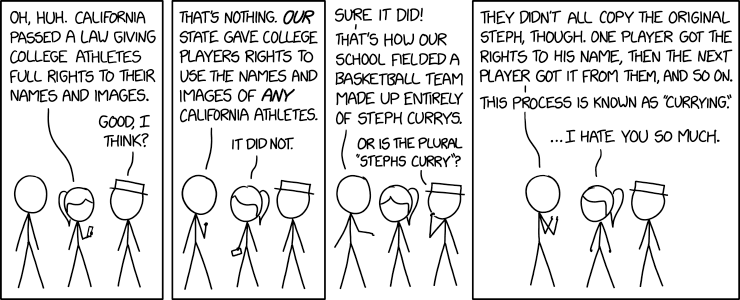
In a more general sense, a rabbit hole is a reference that leads the inquisitive mind to some new field of knowledge that they would have otherwise never even been aware of. They can be sneaked, as easter eggs, into the more popular media, thereby allowing a large candidate audience to find them, even if few ever do. They can also be tagged into memes such that the reference piggybacks on the popularity and spread of the meme. The XKCD site often contains references to obscure pieces of physics and maths that need to be understood before getting the joke. There is an explanation site, but that feels like a bit of a spoiler and a cheat and is kind of a last resort. The following, for example, requires an understanding of lambda calculus, a mathematical topic mysterious even to many computer scientists; part of the fun is working out the puzzle. Curiosity to the reference leads one further down the rabbit hole, and it gets curiouser and curiouser.
There are potential applications for memetics and cliology here. Some memes are light enough to walk with their own legs, others require a propagating index that points to the more bulky and static ideas. This more complex information cannot propagate on its own and so generally needs its audience to know where it resides and to actively access it. One of the challenges for cliology (and other fields such as advertising) is to get people to act on the more complex information in an arena where attention spans are alarmingly short. The last point of the AIDA model of marketing, “Action”, where simple enough to fit in with the advert, can be a direct enticement, but more often than not the action called for is more complex than the advert will carry. The advert then prescribes the action of pursuing a reference along with sufficient incentive to do so: “to find out more visit our site http://cliology.com now!”

Adverts are fully expected to be overt in their intentions. Any meme that has even the faintest whiff of being an advert tends to come over as forced: forcedness is the Dettol of memes. How then might a simple self-propagating meme induce more complex behavioural responses? Lets ask the Easter Bunny. The principle is similar to that of the AIDA case, but for memes: a simple self-propagating meme with an embedded index behaivour pointing to a repository of more complex memes. To avoid seeming forced, the indexing mechanism would be a recombination of the carrier and an easter egg. There is some trade off that while an unforced meme may reach a greater audience, the hidden easter egg will go unnoticed by many – its a numbers game and a matter of careful perceptual targeting. The viral analogue though is that the meme is contagious during incubation before the symptoms appear, and many carriers are likely to remain asymptomatic. Social media users would share quickly, then possibly respond to the call to action at some later time.
However, were the meme to go pandamic, then there would be enough of those who do spot the easter eggs to disappear down the rabbit hole.
Leave a Reply