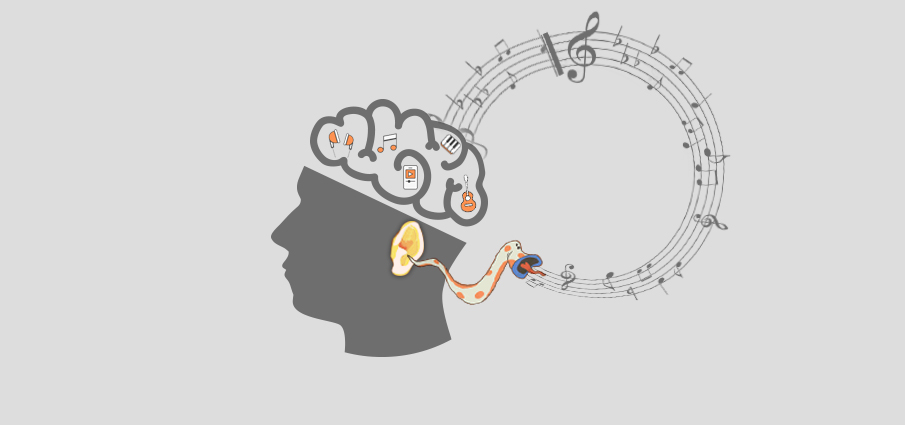
Selection, variation and reproduction are the Darwinian essentials needed to produce a meme. Selection pressure for a piece of music can come from outside of the composer in the form of listener’s tastes and market factors. There is also selection pressure going on inside the composer’s mind before it gets onto manuscript or Digital Audio Workstation.
For me, the first hoop a tune has to jump through is that of being catchy. If some divine inspiration hits me and I get some musical idea, then the test is for it to stick with me for some time. When it can do that, then I know it is potential hook material and could well be the basis of a track.
It is then that the hard work begins. Turning a raw hook into a well-formed production. Well-formedness is a mathematical term. Basically, it means that an expression adheres to a formula, a syntax, by which it makes sense. Here, there are a bunch of criteria that the expression must meet to make it well-formed. In evolutionary terms, a morph or derived variant must also meet the criteria. Where it does, then it persists and could replicate (with variation) onto the next elimination round. The criteria it must meet constitute the selection pressure.
A “well-formed” piece of music, particularly one aimed at the popular market is faced with selection criteria. Highly experimental or avant-garde compositions have niche audiences. Contemporary pop of any sub-genre, on the other hand, follows a cluster of tropes and conventions. A genre is a classification, a boundary that defines the range of traits particular instances of that genre. Genres then, also provide a template for the musician and to write in that genre then a set of general criteria must be adhered to, but with some flexibility in the actual implementation in order to make it unique and fresh. Disregarding those constraints would make a piece seem too unusual to an audience to understand and listen too. The point of pop, and its dependent industries, is to go easy on the mind, something that doesn’t require much thinking about while listening to drive time radio, soaking up the advertising intermissions. Fortunately, for the composer, it is easier to compose within a familiar genre than it is to be radical. The downside is the often-heard lament that “all music sounds the same these days!”
So within the genres formulaic structures, tropes and conventions for well-formedness, we have selection pressure going on in the mind of the musician who aspires to popularity. As said, this is the hard work, as it often turns into an internal wrestling match over subtle, or not so subtle, nuances in order to get a piece to work. What are these boxes that have to be ticked? Well, listening to commercial radio for a while gives us a clue. It gives us an indication of what the listeners and radio station staff are used to and need. Going outside the familiar would confuse them so programming selects tracks for easy consumption.
Firstly, the standard pop song is around three and a half minutes at around 120bpm which does not overtax the attention span. Secondly, it is likely to be structured in the verse-chorus-verse-chorus-middle eight-chorus way, although there are variants, thirdly major keys and 4/4 patterns are popular in contemporary pop. These tend to be the standards.
Truth be told, sticking to that pattern is easy as cranking out unoriginal cliches is facile. Simply copying a tune is to do a cover version, but releasing it as your own material is a no-no, with copywrite ramifications. Yet audiences crave familiarity with some element of newness. Operating within bounded creativity is not so facile; it is about innovating something new and fresh while at the same time sticking to old conventions. Those two selection pressures are contradictory and the art is to be in the Goldy Locks zone between them. Culture goes in waves; musicians, producers and executives know this – particularly where being in that zone, in terms of commercial music, is their bread and butter.
But what are some factors that the song-writer considers, albeit at the unconscious level of mastery? As I have noted, inspiration is not the issue, turning that moment of magical encounter into a product that can attract radio air time, is the true craft here. It is ofter the case that a hook appears out of the blue: a strong riff and a memorable lyrical line originating from a maxim, or aphorism in our back-culture. Obviously, this hook would be a basis, but now needs to meet the other conditions to become a fully-fledged track fit for airplay. The rest of the song might not be furnished by the muses, and so the song-writer has to, somehow, fill in those gaps. A common approach is to put in some nonsense filler as lyrics, a kind of lorum ipsum that acts as a placeholder for later thinking while working on the melody. It could be meaningless gibberish that just fits the meter, or ‘Ohh, baby baby’ type crooning. Nowadays, topliners work over existing music beds. Once again such filler is insufficient to go to market, so deriving a proper song introduces a whole new set of poetic selection pressures.
Semantics comes into play. Often the hook has some meaning that sets the theme and develops into the narrative that the song conveys. Within this context, the lyrics have to support and make sense in progressing the narrative. There can be a jarring effect otherwise where a line is incoherent with the rest of the song. Furthermore, in pop, the words should also be easy to remember, easy to sing along too, and therefore not overy complicated nor cleaver.
A rhyming schema is not a necessity, but contemporary pop usually adopts such as it makes for better memorability and seems to make the result psychologically more satisfying.
The meter of the song is important as it gives it its feel. The rhythm of the wording, ideally, is consistent with the tun and with itself. Sticking lyrical elements over musical ones where they do not match tends not to work well.
The labour of the song-writer then is to meet with such selection pressures (among others). Frequently, for example, half of a verse may work well, but the rest just isn’t happening. It could be that it doesn’t fit sensibly with the story, or the rhyme is too strained, or words are repeated, or for many other reasons. Upon hitting this well-known writers’ block, the lyricist naturally starts to look for variations that might work: shuffling around or introducing new words in an attempt to generate some variant that does fit the bill. I’ve experienced that finding something better can interfere with other parts, or even derail the whole song forcing me to review the project and adapt those older parts that no longer fit the more promising line.
This process of churning possibilities and recombinations around in my head, flip-flopping around attractors and hill-climbing in bounded musical phase space can take weeks or months. Sometimes though, a breakthrough occurs: the line just feels right, it meets the selection criteria and can be admitted conditionally into the work. The final piece has taken a long Darwinian path from dream to demo, but it still has much further to go to get to the audience.
Leave a Reply