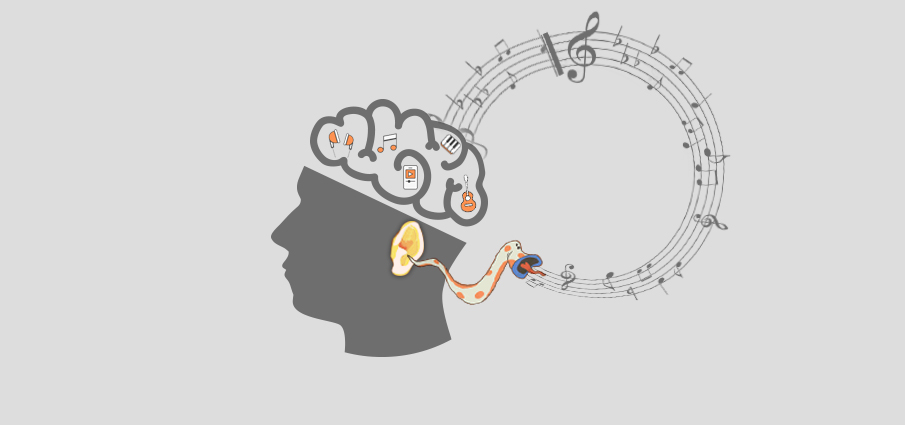
The earworm idea says that more sticky lyrics are those most likely to linger in the mind. This reflects Cambellian evolutionary epistemology whereby Darwinian forces are acting on the memes in the mind. But music, it would seem, is some kind of cognitive gadget – a deeply ingrained inherited human feature. Cultural Evolutionary Psychology must then ask, what is the survival advantage of being a musical ape? In other words what are earworms “for”?
One plausible hypothesis is that they are somehow implicated in language learning. This notion isn’t watertight but might have some practical use for making more sticky earworms.
The learning hypothesis, that music is implicated in pattern recognition and imitation seems to bear out in my attempts to intentionally learn both Japanese and songs for a choir I am a member of. It also seems to fit with the earworms I pick up unintentionally from BBC Radio One which annoy me all day. The phenomenology of this demands attention elsewhere, but for now, I will focus on how a cognitive instinct for auditory pattern acquisition has application in fabricating catchy pop hooks.
 Let’s assume that human neuroanatomy has evolved to facilitate language acquisition. Babies imitate language instinctively – it is a part of our genetic “starter kit”. Those bits of the brain are stimulated in learning and using language, and from a contextual behavioural science perspective, that stimulus becomes reinforcing through social feedback such as praise or correction. An audio sequence looping in the mind helps learning; in our mind’s ear, we repeat a word or phase we have picked up until we get it. This mental rehearsal seems to help the new phrase sink in and become easier to recognise and say, which is somehow satisfying. It also makes what we have learned easier to compare against further examples thereby either reinforcing or correcting our learnings. That sense of “getting it” or having “got it” has a pleasurable aspect and presumably is what the mental looping of audio sequences is about.
Analysing this from a practical direction, we might posit that, as strong earworms must posess reinforcing traits, then we might look to them to figure out what traits we need to make a hit. The distinguishing characteristics of popular music are those that meet a cluster of selection pressures, not only those coming from our received culture, but also of the underlying genetically determined anatomical structures specific to language learning. The traits known for making smash hits could well show us what those neurological tickle-sticks are. My guess is to figure out why they do that, but that is one for later on.
Leave a Reply